
In brief
- An Asset Management Plan needs a clearly defined planning scope, supported by a classification structure that is appropriate for the organisation and portfolio.
- It exists to set the lifecycle decision approach for that scope, including how performance, cost and risk will be considered before decisions have to be made under pressure.
- It has to connect to how the organisation accounts for money, stand on a data foundation other systems can trust, name the people and partners who make it real, and manage risk wider than equipment failure.
- Every decision in it should trace to an objective in the Strategic Asset Management Plan it serves, and feed cost, risk and performance evidence back the other way.

Most documents called an Asset Management Plan are maintenance plans wearing a better cover page. A list of preventive tasks, a criticality rating, maybe a spares list, all correctly done and still not an Asset Management Plan, because maintenance is one input into the decision, not the decision itself.
Asset management is the coordinated activity an organisation undertakes to realise value from its assets, and that value is both financial and non-financial: revenue and cost on one side, service, safety, reputation and risk on the other. An Asset Management Plan is where that balancing act gets made specific for a defined planning scope: what outcomes the assets must support, what they will cost across their lifecycle, how risk will be evaluated and treated within approved criteria, who is accountable, what information has to exist for decisions to be trusted, and what happens when circumstances change. Maintenance strategy answers one part of one of those questions. Everything else in that list is still the plan's job.
This article sets out what belongs in an Asset Management Plan once it is built to the full width of the discipline rather than the width of one function's expertise, how asset classification can help define a consistent planning boundary, and why many organisations understandably complete only the maintenance strategy portion.
What an Asset Management Plan has to cover
- Decisions
- What this asset class must keep delivering, what level of risk is acceptable and who decided it, what criteria decide between repair, refurbishment and replacement, and how the trade-off between holding performance and improving it is made consistently.
- Money
- What spending is capital and what is operating, a whole-of-life cost view rather than an annual maintenance budget, and a connection between condition and criticality data and how the asset is valued and depreciated on the books.
- Delivery
- The preventive, predictive and corrective maintenance mix appropriate to this asset class's actual failure modes, developed through FMECA or RCM, plus how the class is operated day to day and how its projects and shutdowns are planned.
- Data
- A data foundation with an owner, a defined structure and a quality standard: asset classification, a functional location hierarchy, and a failure code library aligned to real failure modes.
- People, partners and supply chain
- Named accountability for the plan and its major decisions, the competencies the class requires and how they are covered, the Bills of Materials and critical spares, and the vendors and OEMs the organisation depends on.
- Risk beyond failure
- What happens when the assumptions underneath the plan change, from a shift in demand or a regulatory change to a supply chain disruption or a climate-related event, and what triggers an out-of-cycle review.
Set the Planning Boundary Deliberately
An Asset Management Plan needs a defined scope, and that scoping decision is what makes everything downstream specific enough to act on rather than aspirational enough to ignore. Depending on the organisation and portfolio, the boundary may be an asset class, asset group, system, service or another coherent planning unit.
A crusher and a conveyor may not carry the same criticality, demand profile, failure economics or capability requirements. A single plan should cover both only when they share enough decision context for the plan to remain specific and useful. Where their lifecycle strategies, risk profiles, funding or accountabilities differ materially, separate planning scopes are usually clearer.

This is where asset classification becomes a practical planning aid rather than a side project. Asset class, asset class type and asset class type variation can provide increasingly precise planning boundaries when those levels reflect the organisation's real demand, risk, delivery and lifecycle differences. The exact taxonomy and level used should match the portfolio and the decisions the plan needs to govern. Ambiguity in the selected boundary will become ambiguity in the plan.
The Decisions It Actually Has to Make
Strip away the paperwork and an Asset Management Plan exists to answer a small number of genuinely hard questions, deliberately, rather than by default.
What service or output does the planning scope have to keep delivering, now and as demand changes. Which approved risk criteria and decision authorities apply, given the consequence profile. Where a repair, a refurbishment or a full replacement are all technically viable, what criteria decide between them, and at what point in the asset's condition does that decision get triggered rather than argued about during an outage. How much should be spent maintaining current performance versus improving it, and how is that trade-off made consistently across a portfolio rather than won by whoever argues loudest at budget time.
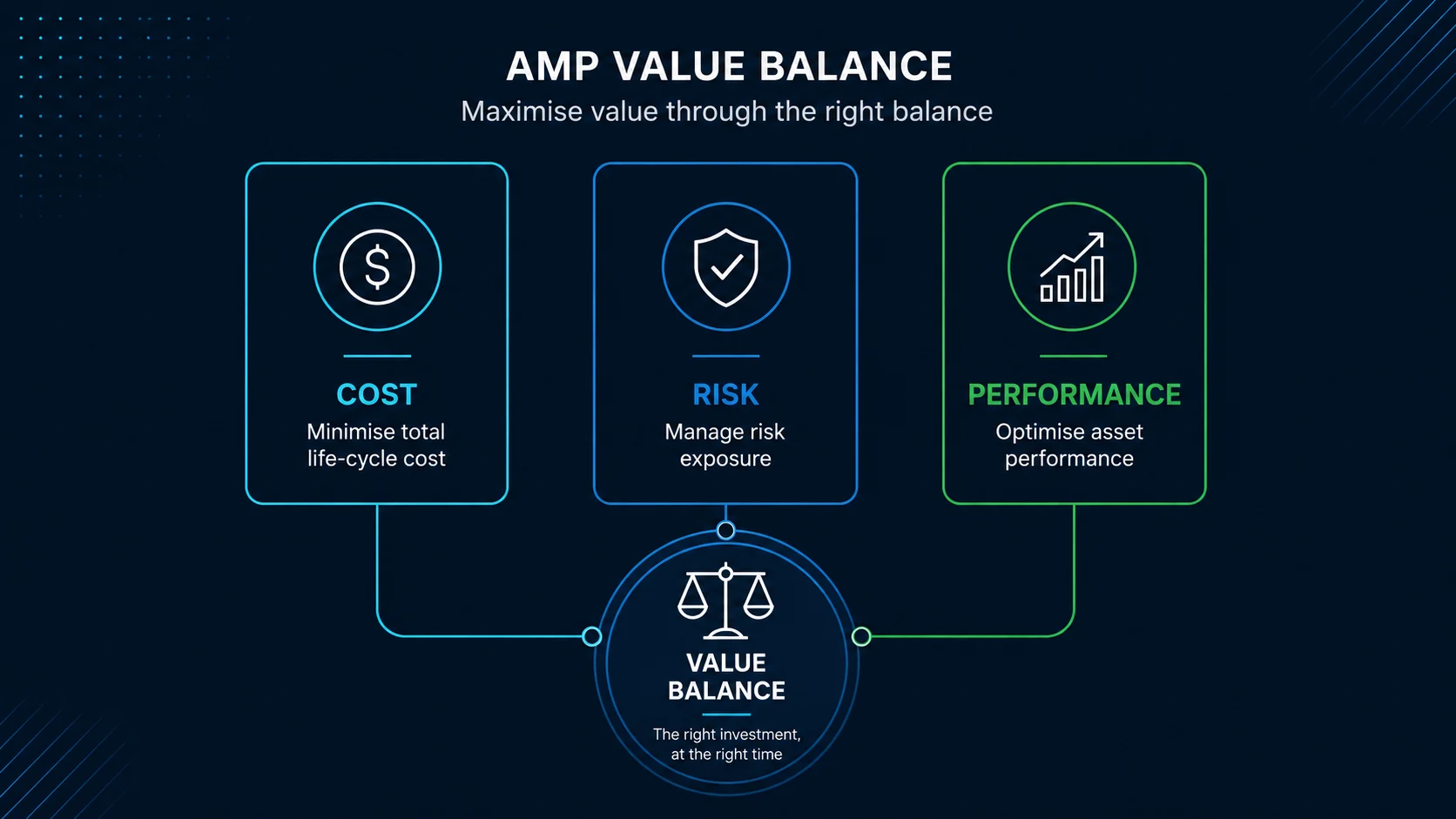
Most organisations do make these decisions. What they don't do is write down the criteria beforehand, which means the same decision gets re-litigated from scratch every time it comes up, usually under pressure, usually inconsistently between sites. An Asset Management Plan that only describes the current maintenance regime has skipped the harder and more valuable job: setting out, in advance, how this asset class's cost, risk and performance trade-offs will actually be decided.
Where the Money Lives
A plan that engineering trusts and finance quietly works around is not a functioning Asset Management Plan, it is two separate versions of the truth that happen to describe the same equipment.

This is the dimension a purely technical plan almost always leaves out, and it is usually the one that determines whether the plan gets funded at all. The plan should use finance approved classifications and governed information to align lifecycle decisions with financial planning and reporting. Capital and operating treatment, valuation and depreciation remain subject to the organisation's accounting policies and applicable reporting requirements. A whole of life cost view is still essential, because a decision that looks inexpensive this year and costly across the lifecycle is not the inexpensive decision. Engineering evidence and financial information need to be reconciled so condition, criticality, lifecycle options, budgets, valuation and reporting describe the same asset reality. That requires finance to be a partner in the plan, not a function that receives the invoice afterwards.
Delivering It
This is the layer most asset management content starts with, spends all its time on, and mistakes for the whole plan.
Once the decisions and the money are set, the plan needs a genuine, analytically grounded delivery strategy: the preventive, predictive and corrective maintenance mix appropriate to this asset class's actual failure modes, developed through FMECA or RCM rather than inherited from whatever the previous site did; how the asset class will be operated day to day within its design envelope; how acquisition, renewal or upgrade projects for this class will be planned and executed; and how shutdowns or outages affecting it will be scheduled and managed. This is real, necessary work, and it is where a lot of Shivaan Asset Management's own hands-on expertise sits. It is also, on its own, only one of several equally necessary dimensions. A plan that is excellent here and silent everywhere else is a strong maintenance strategy that has borrowed a bigger title.
The Data Foundation
None of the decisions above are worth much if the system underneath the plan cannot be trusted to record what actually happened.

Treat this data the same way you would treat any other asset the organisation depends on: it needs an owner, a defined structure and a quality standard, not just a database. Asset classification provides a consistent view of what an asset is. A properly built functional location hierarchy provides a distinct view of where it sits and how location based data rolls up. These parallel structures support governed asset records and failure data aligned to real failure modes. When the foundation is weak, technicians fall back on free text and reliability analysis, financial reconciliation, dashboards and any AI based analysis inherit the same weakness. When asset information is governed well, technical, financial and assurance decisions become faster and more trustworthy.
The People, Partners and Supply Chain Behind It
A well-reasoned plan with nobody accountable for it and no parts to execute it is a plan on paper only.
The plan should name who owns it and who is accountable for each major decision, not leave accountability implied. It should state the specific competencies this asset class requires and how the organisation currently covers them, across its own workforce and its contractors, and it should name where deep troubleshooting knowledge currently sits in one or two people's heads rather than in the organisation's systems, because that is a resourcing risk worth writing down, not a fact to discover when someone resigns. It should define the Bills of Materials for the class, built from the same classification structure so identical asset class type variations share BoMs instead of duplicating parts lists under different names, identify genuinely critical spares based on failure consequence and lead time, and name the approved vendors and OEMs, where the organisation is single-sourced and exposed, and what happens as an ageing asset class approaches the end of OEM support. Culture matters here too: a plan nobody feels ownership over gets treated as compliance paperwork, and compliance paperwork is exactly what does not survive contact with a production target.
Risk Beyond Failure
Failure-mode risk is the risk most Asset Management Plans manage, and it is only ever one part of the risk picture for an asset class.
The plan should also account for what happens when the assumptions underneath it change: a shift in demand, a regulatory change, a new safety case, a supply chain disruption, or a climate related event affecting assets designed for different conditions. It should identify change triggers for review and be tested against actual performance, not simply reapproved on a calendar date. A plan that considers equipment failure alone leaves other material risks and opportunities outside the decision.
Keeping It Alive
The organisations that get real value from their Asset Management Plans treat every one of them as a live management tool with an owner and a rhythm, not a document produced once for an audit and reopened only when the auditor comes back.
Every decision in the plan should trace to a specific objective in the Strategic Asset Management Plan it serves, and the line of sight has to run both ways: the AMP doesn't just receive objectives from the SAMP, it feeds back the cost, risk and performance evidence that tells the next SAMP review whether those objectives were realistic in the first place. That feedback loop, more than any individual section of the document, is what separates an Asset Management Plan that governs real decisions from one that quietly goes out of date the week it is approved.
The Plan That Actually Covers the Discipline
An Asset Management Plan done properly is a genuinely cross functional document. Engineering has a stake in it. So do operations, finance, procurement, people and capability teams, and the people who govern asset information systems. That is precisely why many plans fall short: they are written by one function, in that function's language, and the other stakeholders never really adopt them.
Build one that sets out decisions deliberately, uses approved financial and risk frameworks, delivers through an analytically sound maintenance and operations strategy, stands on a data foundation that other systems can trust, and names the people and partners who make it real. That is how the SAMP stops being an aspiration and starts shaping how the organisation manages its assets.
Frequently asked questions
Is an Asset Management Plan the same as a maintenance plan?
No. Maintenance is one input into the decision, not the decision itself. A list of preventive tasks, a criticality rating and a spares list can all be correctly done and still not add up to an Asset Management Plan, because the plan also has to define required outcomes, lifecycle cost and funding, approved risk decision criteria, accountability and the asset information needed to support trusted decisions.
How many Asset Management Plans does an organisation need?
The right number follows the organisation's planning boundaries. A plan may cover an asset class, asset group, system or other defined scope when the assets share a meaningful decision context. Separate plans are useful when demand, risk, lifecycle strategy, funding or accountability differ enough to require distinct decisions.
How does an Asset Management Plan relate to the SAMP?
Every decision in the plan should trace to a specific objective in the Strategic Asset Management Plan it serves, and the line of sight runs both ways: the plan also feeds back the cost, risk and performance evidence that tells the next SAMP review whether those objectives were realistic in the first place.
What has to be in place before writing one?
Start with a defined planning scope, the organisational objectives and asset management objectives it supports, and enough trusted asset, performance, risk, cost and demand information to make defensible decisions. Asset classification and functional location structures can then provide consistent views of what the assets are and where they sit.
Who should be involved in writing one?
An Asset Management Plan done properly is a genuinely cross functional document. Engineering has a stake in it, and so do operations, finance, procurement, people and capability teams, and whoever governs the asset information systems. That is precisely why many plans fall short: they are written by one function, in that function's language, and the other stakeholders never really adopt them.
Build Asset Management Plans That Cover the Whole Discipline
If your organisation's Asset Management Plans read like maintenance schedules with a different cover page, missing the financial, data, and organisational dimensions that make them genuinely governable, Shivaan Asset Management works with asset-intensive organisations to build Asset Management Plans that hold together across engineering, finance and the floor.