
Industry agnostic
Applicable across all heavy asset industries.
Standardised asset data, trusted decisions, AI-ready foundations.
A maintenance or investment decision is only as good as the records it is read from. Standardising asset data is the work that makes those records dependable, at every site and in the same terms.
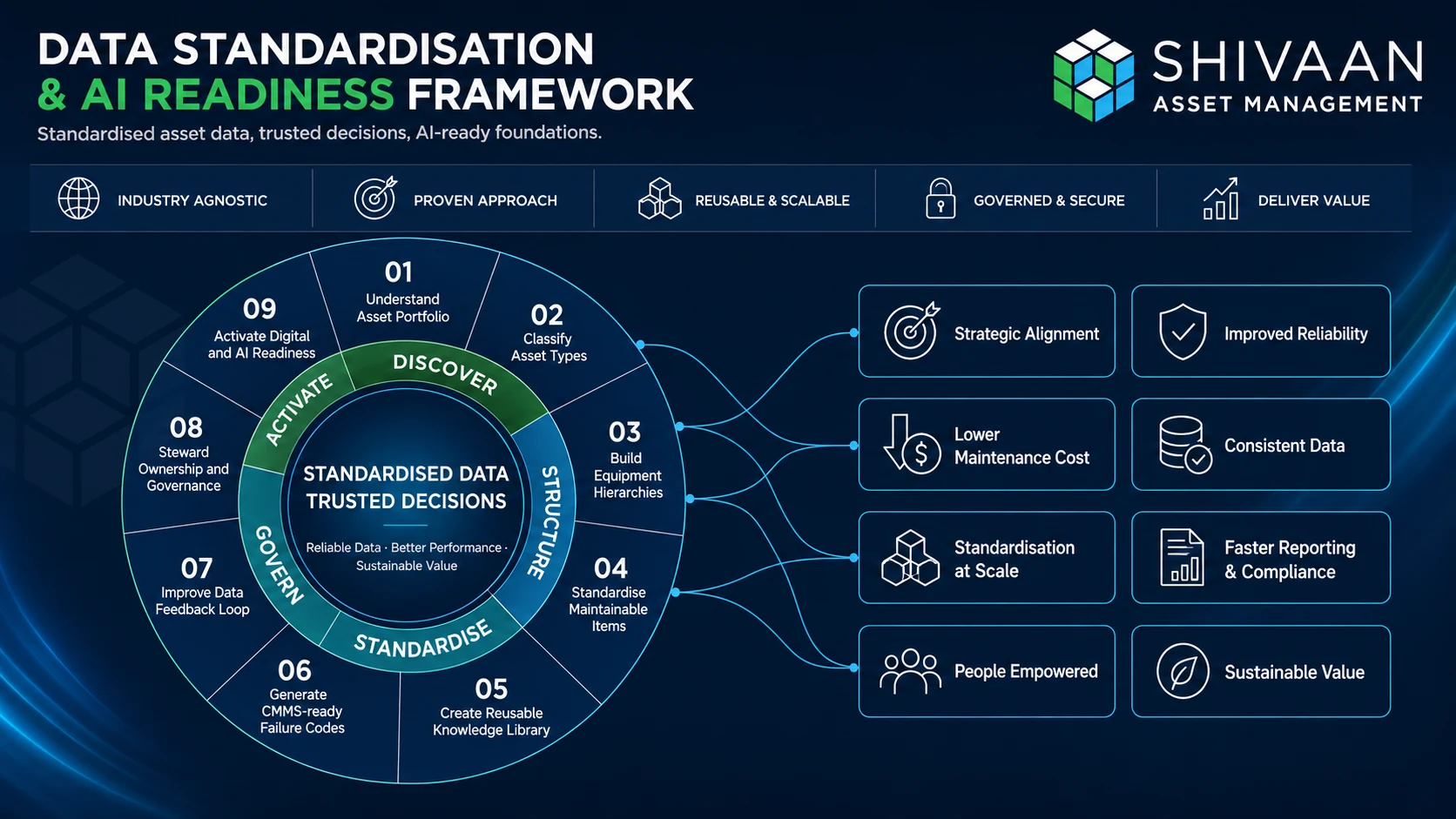
This framework is how Shivaan Asset Management does that work. Five phases and nine steps take an asset base from records kept a different way at every site to standardised data that reporting, optimisation and AI can stand on. It is written to be learned and applied by anyone, in any heavy asset industry.
Structured data is the prerequisite for every capability that follows, not the afterthought once the tools are bought. Each step below sets out what it is, why it matters and the value it returns.
These hold true at every step, in any heavy asset industry.
Applicable across all heavy asset industries.
Engineered for real-world complexity.
Create once, use many, grow with confidence.
Trusted data with clear ownership and control.
Outcomes the business can see and measure.
The phases run in sequence. Each one makes the next possible, so nothing downstream is built on data that has not been agreed. Every step sets out what it is, why it matters and the value it returns.
01
Know what you have, and classify it by design, before anything else.
What it leaves in place. The asset scope is mapped and organised into a consistent, three-level classification that every later step reuses.
01
Map every physical asset: what exists, where it operates, who owns it and the function it performs, with its operating context and functional boundaries.
02
Organise every asset into three levels: asset class, asset class type, and the variations where design differences change how an asset fails or is maintained.
02
Decompose each asset to the component, then standardise the language of its maintainable items.
What it leaves in place. A complete engineering breakdown and a shared, controlled vocabulary of maintainable items that reads the same at every site.
03
Decompose each asset class type from the system level down to the component, using engineering logic: system, sub-system, assembly, sub-assembly, component.
04
From the equipment hierarchy, extract and standardise every maintainable item and component under controlled nomenclature, so the same thing is named the same way everywhere.
03
Turn failure knowledge into a reusable library, then into load-ready CMMS failure codes.
What it leaves in place. A templated RCM knowledge library and CMMS-ready failure codes, structured to deploy at scale across any site.
05
Develop a reusable engineering library of failure modes, mechanisms, causes, effects and maintenance task logic, captured at component level in standardised terms.
06
Convert the library into structured failure code sets, Problem, Cause, Remedy (PCR), formatted for the target CMMS such as SAP PM or Maximo, with every record traceable to a failure mode in the library.
04
Close the loop so the data improves itself, and give it clear, lasting ownership.
What it leaves in place. A self-sustaining improvement system, owned and stewarded independently of any one person.
07
Establish the governance cycle that feeds work order history, condition monitoring and incident records back into the library.
08
Assign clear ownership, set a review cadence, and embed the framework into standard operating practice across operations, maintenance and engineering.
05
Activate dashboards, analytics and AI on data you can finally trust.
What it leaves in place. Reporting, optimisation and AI decision support running on foundations that were engineered to be AI-ready.
09
With standardised data in place, activate the digital layer: dashboards that show meaningful signals, analytics that surface real failure patterns, and AI models that learn from clean, consistent data.
What standardised, AI-ready asset data delivers back to the business.
Strategic alignment
Asset decisions tied to board-level business priorities.
Improved reliability
Safer, more available and more predictable assets across the portfolio.
Lower maintenance cost
Less waste and more value from every maintenance dollar spent.
Consistent data
Reports and decisions everyone in the business can trust.
Standardisation at scale
One language across every site, asset class and team.
Faster reporting and compliance
Audit-ready evidence and regulatory reports without delay.
People empowered
Teams confident using clean data to make better calls.
Sustainable value
Asset performance and value maintained across the full asset life.
Three engagements built on this sequence. Every figure below is the figure already published on that project page.
78%
Failure-code adoption within 8 months, from no prior use of codes
A global mining operation standardised 100+ asset classes and 150+ asset class type variations, then crews began coding failures with the standardised codes and left less of the history in free text.
5.0 / 5.0
Every one of 11 independent client assessment dimensions
A Tier 1 oil and gas operator standardised 5 asset classes and 44 asset class types, ending with 100% standardisation across all deliverables and a Net Promoter Score of 10 out of 10.
2 sites
Coal handling and preparation plant functional locations standardised
An audit across two coal mine plants produced one governed enterprise master data standard covering how functional locations are created, owned and audited, positioning the client's asset management system for ISO 55001 alignment.
The vocabulary the framework standardises.
The building blocks the phases rely on, written up in full in our resources.
Asset data standardisation is the work of making an organisation's asset records dependable and consistent, so the same asset, component and failure are described the same way at every site. It covers understanding and classifying the asset portfolio, building equipment hierarchies, agreeing a shared ontology of maintainable items, and generating CMMS-ready failure codes.
AI readiness means the underlying asset data is structured, consistent and coded well enough for dashboards, analytics and AI models to produce credible results. Structured data is the prerequisite for those capabilities, not an afterthought once the tools are bought.
Understand the asset portfolio, classify asset types, build equipment hierarchies, standardise maintainable items, create a reusable knowledge library, generate CMMS-ready failure codes, improve the data feedback loop, steward ownership and governance, and activate digital and AI readiness. They are grouped into five phases: Discover, Structure, Standardise, Govern and Activate.
A maintainable item is the lowest level in the asset breakdown that is actually maintained, replaced or repaired as a unit. Standardising the names of maintainable items is what makes asset data reusable and CMMS-compatible across sites.
It is industry agnostic and applies across the heavy asset industries, including mining, oil and gas, rail, smelting and refining, manufacturing and utilities. The method is the same; only the assets differ.
Start with the data you already have. Tell us where your asset data stands today and we will show you which phase to begin in, whether that is classifying the portfolio, standardising maintainable items, or governing an improvement loop you already run.
Tell us where your asset data stands today and we will show you which phase to start in.