
In brief
- Asset criticality analysis is a structured assessment of the consequence of asset failure on organisational objectives, used to rank assets and calibrate the management effort each one justifies.
- Criticality and risk are not the same thing: criticality is the consequence of failure, and risk combines that consequence with the likelihood of the failure occurring.
- Criticality begins at design and is carried into service through operational readiness, so operations inherits a working register on day one rather than reconstructing one years later.
- Consequence rolls up from component failure modes through the asset and the process to the site view, so every level of the business reads the same analysis at its own altitude.
- The ratings steer maintenance strategy depth, spares, inspection and capital, and the whole discipline is governed through the strategic asset management plan and the asset management plans beneath it.
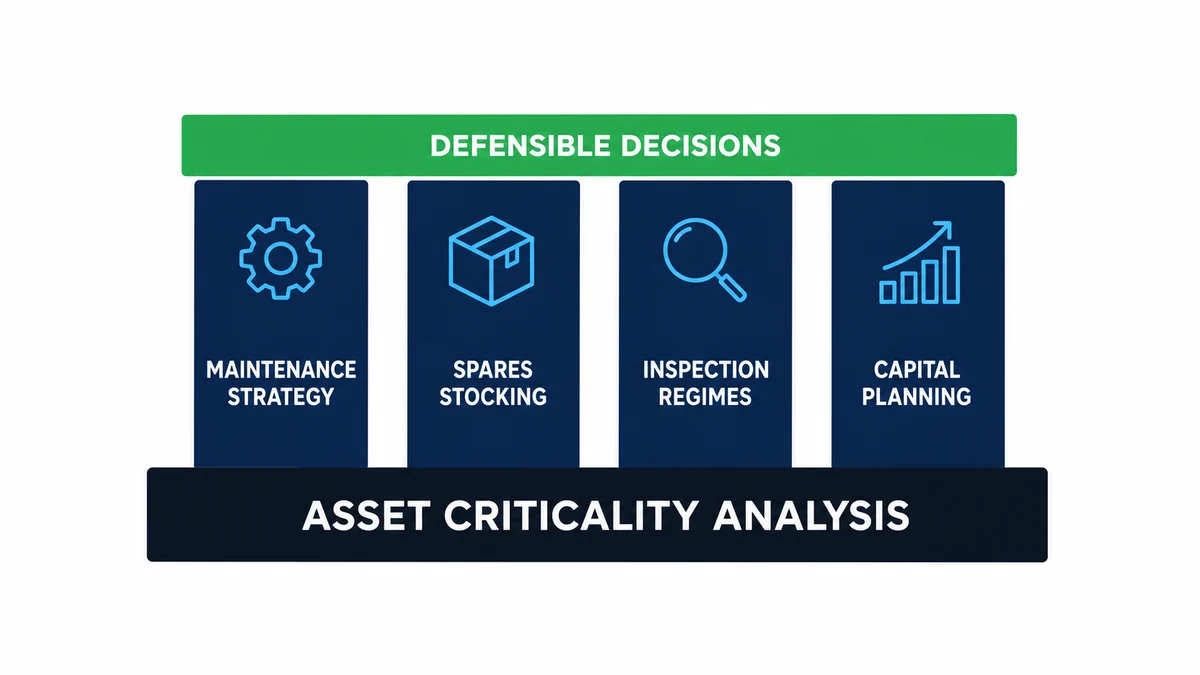
Every asset-intensive organisation makes thousands of prioritisation calls each year. Which equipment receives a detailed maintenance strategy. Which spare parts are held on site and which are ordered on demand. Which inspection intervals tighten and which relax. Which renewal projects enter next year's capital plan. Asset criticality analysis is the structured methodology that gives every one of those decisions a defensible analytical basis, by answering one question with rigour: how much does this asset matter to the organisation, and what happens if it fails?
The GFMAM Asset Management Landscape Third Edition describes the accurate identification and understanding of criticality and risk as foundational to the success of an organisation's approach to asset management. The same document expects the strategic asset management plan to record the methodology used to determine asset criticality, which places criticality analysis inside the governance architecture of an ISO 55001 aligned asset management system rather than leaving it as a departmental exercise. When the methodology is sound, every prioritisation decision that flows from it inherits that soundness.
This article explains what asset criticality analysis is and how it differs from risk assessment, how to build a consequence framework that aligns with your corporate risk matrix, where criticality begins in the asset lifecycle and how operational readiness carries it into service, how consequence rolls up from component failure modes to a site-wide view, what the ratings drive, what changes them, and how the whole discipline is governed through the strategic asset management plan and the asset management plans beneath it.
What Asset Criticality Analysis Is, and How It Differs from Risk Assessment
Criticality and risk are closely related, and they are not the same thing.
- Asset criticality
- A function of the relative importance of an asset or system to the organisation's overall mission, and a stable property of the asset.
- Risk
- A function of that criticality, the impact of failure, combined with the likelihood of the failure occurring.
- Likelihood
- Moves with asset condition, operating context and the effectiveness of the maintenance strategy.
Asset criticality analysis is a structured assessment of the consequence of asset failure on organisational objectives, used to rank assets by their relative importance and to calibrate the management effort each asset justifies. The output is a criticality rating for every assessed asset, recorded against the asset register, that shows the organisation where failure carries the greatest consequence: in safety, in the environment, in production and revenue, in community standing, or in legal and regulatory compliance.
The GFMAM Asset Management Landscape draws the distinction precisely. Criticality is a function of the relative importance of an asset or system to the organisation's overall mission. Risk is a function of that criticality, the impact of failure, combined with the likelihood of the failure occurring. ISO 31000 frames risk the same way: the effect of uncertainty on objectives, assessed through the consequence of an event and the likelihood of it occurring.
The distinction matters in practice. Criticality is a stable property of an asset: it is set by what the asset does, where it sits in the process, what redundancy backs it up and what a failure would cost across every consequence dimension. Likelihood moves with asset condition, operating context and the effectiveness of the maintenance strategy. An asset with a robust strategy and healthy condition presents low risk today while remaining highly critical, because the consequence of failure has not gone anywhere. Manage the two separately and you can see, at any moment, both where consequence concentrates and where current exposure sits.
Why Criticality Comes Before Every Other Prioritisation Decision
Resources are finite, and consequence is not evenly distributed across the asset base.
A working asset register in the heavy asset industry runs to thousands or tens of thousands of maintainable items. No organisation can apply the same analytical depth, the same inspection intensity and the same stocking policy to all of them, and no organisation should. A small proportion of assets carries the large majority of the consequence. Criticality analysis identifies that concentration and turns it into an explicit, agreed ranking that every function can plan against.
That ranking is what makes the rest of the asset management system efficient. Maintenance strategy development effort lands first on the assets where failure matters most. Engineering attention, condition monitoring spend and OPEX, the operating expenditure consumed by routine maintenance, spares and labour, are allocated in proportion to consequence rather than spread evenly. Working capital tied up in spare parts is justified asset by asset against the production loss it protects. CAPEX, capital expenditure on renewal and upgrade, is queued by consequence rather than by asset age alone.
There is also a governance reason criticality comes first. The criteria used to judge consequence derive from organisational objectives and from risk appetite, the level of risk the board is prepared to accept in pursuit of its objectives. When the criticality framework mirrors the corporate risk framework, an extreme rating on an asset means the same thing as an extreme rating anywhere else in the enterprise risk management system, and asset decisions become legible to the boardroom. This is the line of sight an ISO 55001 aligned system is built to achieve, running from organisational objectives through the strategic asset management plan into every maintenance and capital decision.
Building the Framework: Consequence Dimensions, Likelihood and the Criticality Matrix
A sound criticality framework borrows its structure from the organisation's own risk matrix.
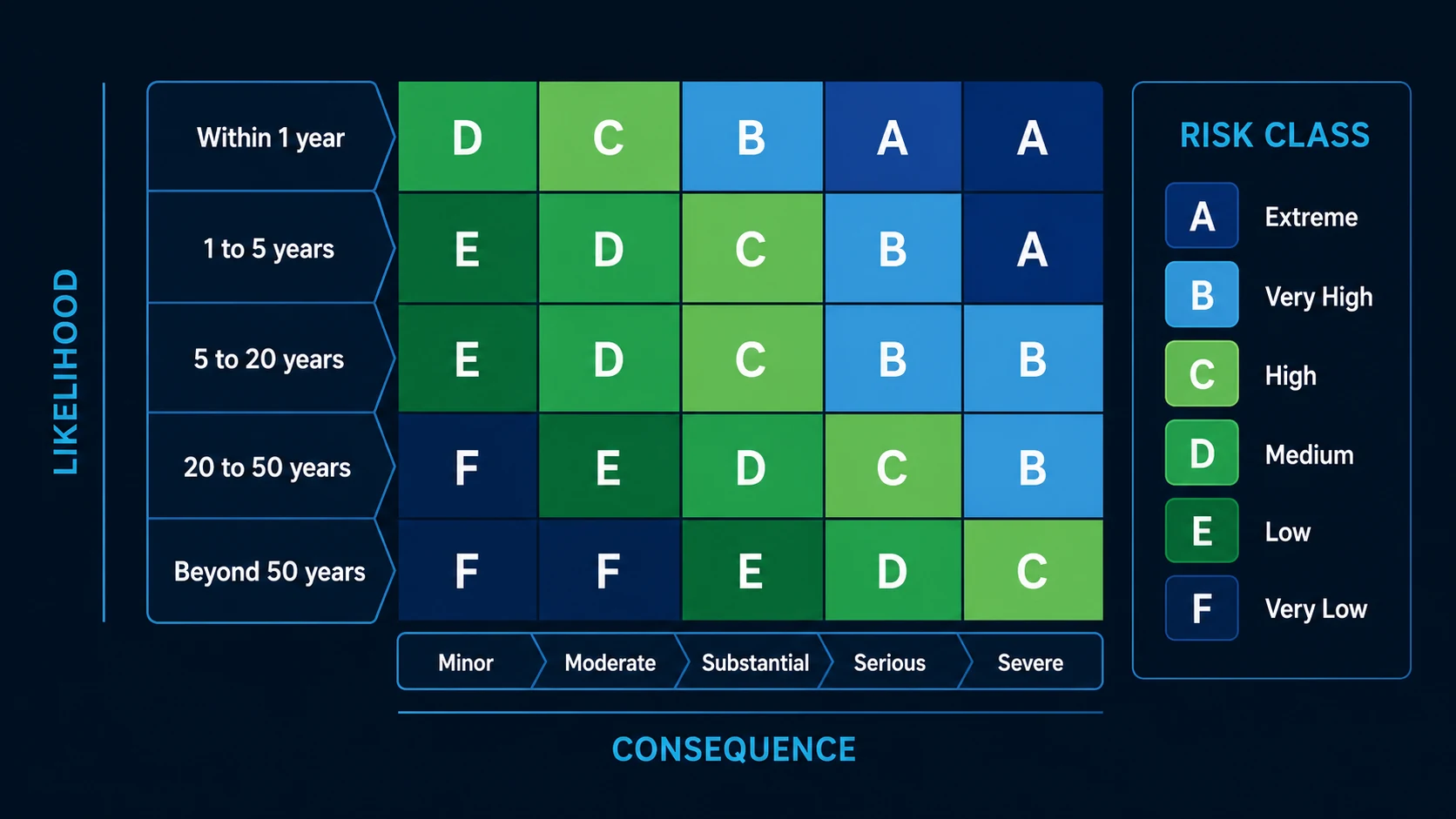
Consequence is assessed across every dimension in which failure affects the organisation, not production alone. A well-built framework assesses each failure scenario against safety and health, environment, production and financial impact, community and reputation, and legal and compliance. Each impact type is scored on a defined severity scale, and the highest-scoring impact type governs the asset's rating. A conveyor whose failure presents modest production loss but a serious safety exposure is rated by the safety consequence, and that is precisely the point of assessing all dimensions.
Financial consequence is expressed in real numbers wherever possible. Production loss cost per hour, the revenue foregone for each hour of unplanned downtime, is the anchor figure: for bottleneck equipment in the heavy asset industry it commonly ranges from tens of thousands to several hundred thousand dollars per hour. Likelihood is most usable when expressed in operational timeframes rather than abstract probabilities: bands such as likely within one year, within one to five years, within five to twenty years, within twenty to fifty years, and beyond fifty years give a cross-functional team something they can reason about from operating history and engineering judgement.
The matrix brings the two together. Consequence sets the criticality class; likelihood is assessed against it to produce the risk class that drives treatment priority, commonly banded A through F or extreme through very low. Both are written into the CMMS, the computerised maintenance management system, against every equipment record, where consequence sets the criticality indicator. In SAP PM this is the ABC indicator; Maximo carries an equivalent field. The two scales are distinct: the criticality class is consequence-based and commonly runs to three bands, A, B and C, or high, medium and low, of which the SAP ABC indicator is the familiar example, while the risk class is the six-band A to F output of the matrix above. Holding them apart is what lets a consequence-only criticality class exist at the design stage, before any likelihood is assessed. Once the rating lives in the CMMS it appears on every work order and notification, which is what allows criticality to steer daily prioritisation rather than sit in an annual report.
Calibrating against risk appetite
Some ratings warrant more than a maintenance response. Where a combination of consequence and likelihood lands outside the organisation's risk appetite, the asset moves out of routine prioritisation and into formal risk treatment: engineering controls, added redundancy, design change or accelerated renewal, tracked through the corporate risk register until the residual risk returns to a tolerable level. Building this trigger into the criticality matrix keeps the asset management system aligned with the enterprise risk management framework, exactly as ISO 31000 intends.
Where Criticality Begins: Design and Operational Readiness
The first criticality rating an asset receives is set long before the asset turns for the first time.
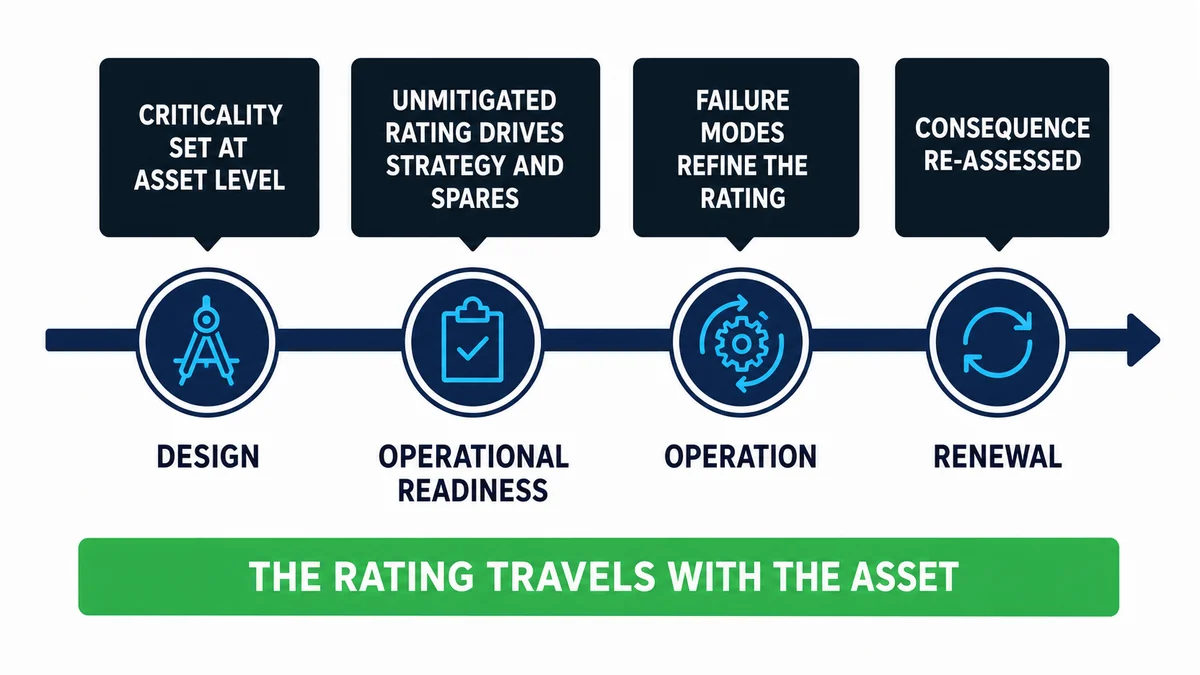
Criticality enters at the design stage, and at asset level. When a project team sizes equipment, selects redundancy configurations and sets the sparing philosophy for a new facility or expansion, it is making consequence decisions whether it names them or not. Design is where consequence is cheapest to change: adding a standby unit on the drawing board costs a design revision, while adding it after commissioning costs capital works, downtime and re-engineering. Assessing criticality during design, against the asset's intended duty and its position in the process, gives the project a consequence map before a single maintenance strategy is written, and it exposes the design choices that quietly create A-class assets, top of the consequence-based criticality scale, where B-class assets would have served.
Operational readiness carries those early ratings into service. A well-run operational readiness program assesses every new asset before handover, initially unmitigated, with no strategies or spares assumed in place, so the rating drives maintenance strategy development, spares planning and the CMMS build rather than trailing them. The final rating, with its mitigations defined, is recorded at handover. Operations then inherits a criticality register on day one instead of reconstructing one years into the asset's life from incomplete memory and work order history.
Organisations that operate multiple sites with similar assets hold an advantage worth using deliberately. Where comparable equipment already runs elsewhere in the business, its component-level failure mode libraries, maintenance strategies and criticality reasoning transfer to the new asset as a starting point. The transfer is a calibration, not a copy. The same equipment model carries a different criticality in a different process position, duty cycle and production context, so the inherited library is re-rated against the new asset's position in the operation and the value it is expected to generate. Done well, this compresses months of operational readiness analysis into weeks and hands the new site the benefit of every failure the wider fleet has already learnt from.
From Component Failure Modes to the Site View
A criticality rating matures into asset intelligence the moment it connects to failure modes.
In operation, criticality becomes far more useful than a letter against an equipment number. Mature organisations define failure modes at component level within a structured equipment hierarchy development, where each maintainable item carries the specific ways it can fail, how each failure is detected and what task manages it. That structure is the prerequisite for everything that follows: without a sound hierarchy, failure modes have no stable home and consequences have no path to roll up.
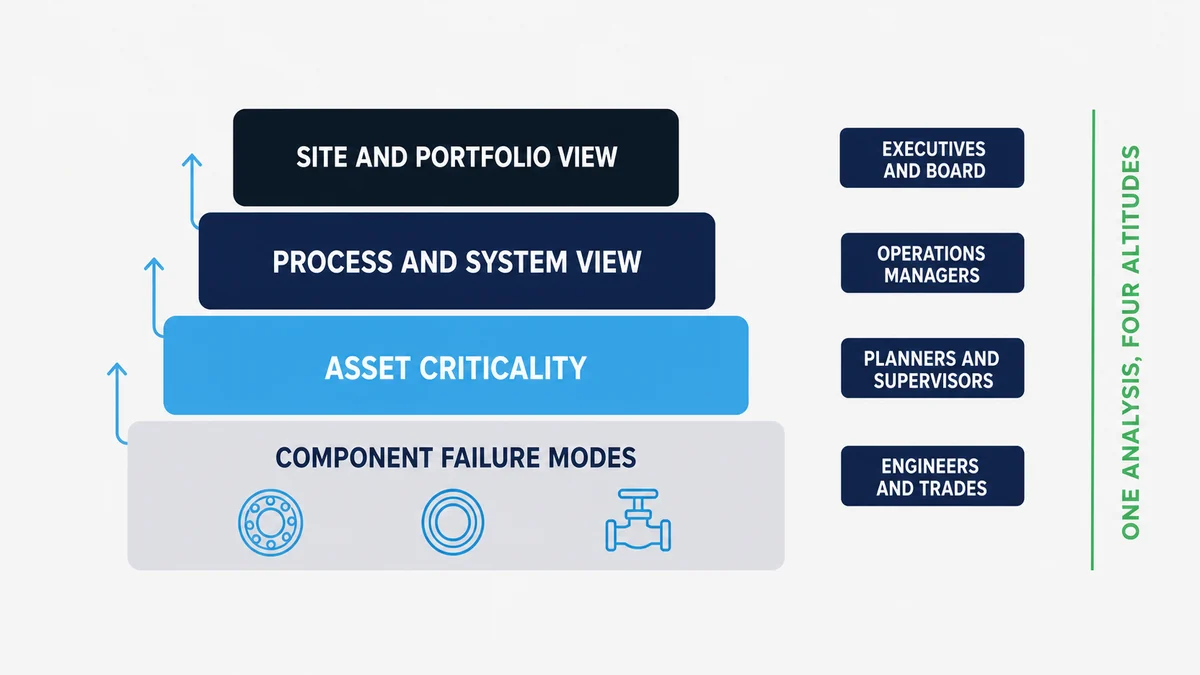
With the structure in place, consequence flows bottom up. Each component failure mode carries a defined effect at the asset: some degrade output, some stop the asset outright, some create a safety or environmental exposure. Asset-level consequences aggregate to the process or system the asset serves, and process consequences aggregate to the site. The roll-up converts thousands of component-level facts into a coherent picture: which assets are critical, which failure modes are feasible on them, and how each one is being managed.
That picture serves every level of the business, because each level reads it at its own altitude:
| Level | The question it answers |
|---|---|
| Reliability engineers and trades | What can fail, how is it detected, which task manages it |
| Planners and supervisors | Which equipment gets which strategy, priority and spares |
| Operations and asset managers | Where consequence concentrates in the value chain |
| Executives and the board | Which assets are critical, and is each one demonstrably managed |
One analysis, four altitudes. The tradesperson's failure mode record and the director's critical asset list are the same data at different heights, which is exactly what gives leadership confidence that what the board sees reflects what the field knows.
Running the Assessment: From Asset Hierarchy to a Defensible Rating
The quality of a criticality assessment is set by the discipline of the failure scenario behind it.
Assess at the right level of the asset hierarchy. Criticality assessments work best at the equipment unit level, the pump, the conveyor, the transformer, the gas turbine, which is Level 6 in the ISO 14224 equipment hierarchy; the maintainable item sits below it at Level 8. Assessing whole plants produces ratings too blunt to steer decisions, and assessing individual components multiplies the effort with no gain in decision quality; components contribute through their failure modes, which roll up to the equipment rating as described above.
Build each rating on a credible worst-case functional failure scenario. One failure, under normal operating conditions, with installed redundancy and standby equipment doing its job, and with reasonable recovery actions accounted for: expediting spares, operating at reduced throughput, completing realistic repairs. The scenario that qualifies is the one a practitioner would defend as genuinely credible within the asset's lifecycle, not the theoretical catastrophe and not the optimistic case. This scenario discipline is what makes a criticality register defensible rather than subjective.
Run the assessment with a cross-functional team, and record the reasoning, not just the result. Operations brings the production consequence, maintenance brings failure behaviour and recovery reality, engineering brings design intent and redundancy knowledge, and safety and environmental specialists validate those impact types. Every assumption, scenario description and severity selection belongs in the assessment record, held in the CMMS or asset performance management tool. A criticality rating that carries its documented rationale can be audited, challenged, updated and trusted.
What Criticality Drives: Strategy Depth, Spares, Inspection and Capital
The value of a criticality register is realised the moment its output starts steering decisions.
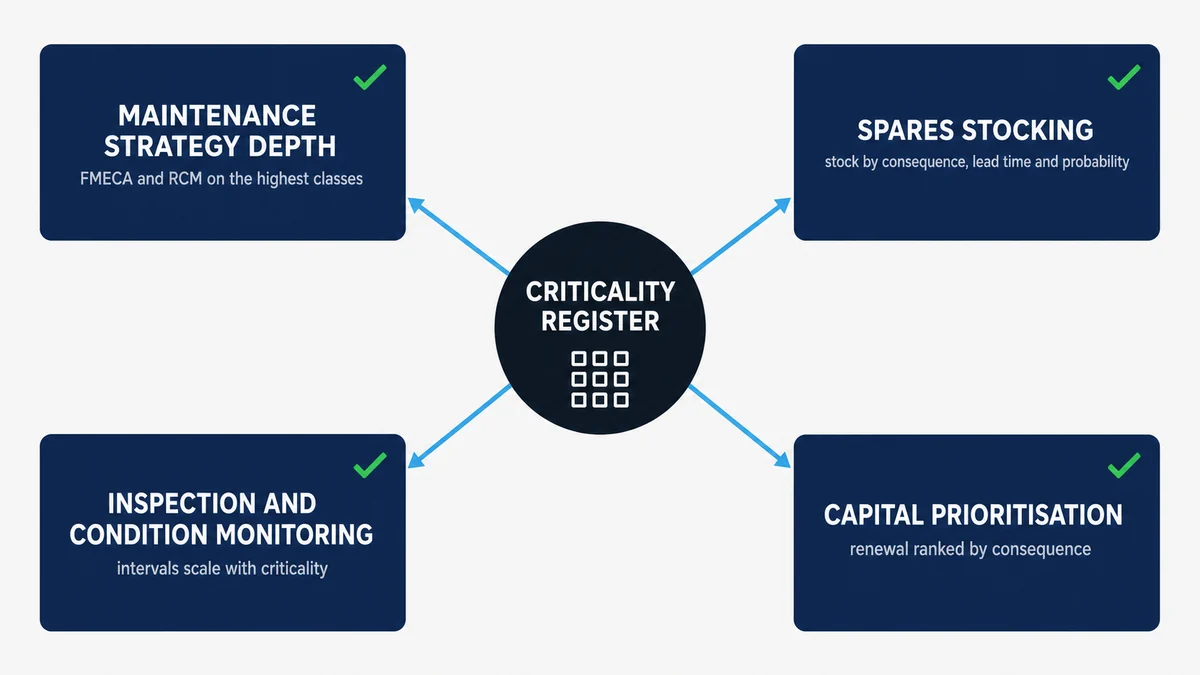
Maintenance strategy development is the first and largest consumer. Criticality determines the analytical depth each asset receives. The highest criticality classes justify full FMECA and RCM analysis: failure modes, effects and criticality analysis identifying what can fail and what it means, feeding reliability centred maintenance task selection. Mid classes suit streamlined or template-based strategy development. The lowest classes are frequently best served by a deliberate, documented run-to-failure decision. OEM maintenance recommendations, which are typically generic and take little account of operating context, usage or consequence of failure, are refined against the asset's actual criticality, and that refinement is where significant OPEX efficiency is found.
Spares stocking decisions draw directly on the same ratings. Whether a part is held on site, held regionally or ordered on demand is an expected value decision connecting criticality, failure probability, lead time and the production loss a stockout would cause. Critical long-lead items justify insurance spares, capital held specifically against a low-probability, high-consequence failure. The working capital conversation with finance becomes straightforward when every stocked line traces to a criticality rating and a quantified consequence.
Inspection and condition monitoring intensity scales the same way. High-criticality assets attract tighter inspection intervals and more capable condition monitoring techniques; lower classes are covered by routine operator care. Capital planning uses the register to rank renewal and upgrade candidates by consequence, which gives the CAPEX queue an analytical spine and gives the board confidence that capital provisioning follows enterprise risk rather than asset age alone. At the daily level, the criticality indicator on every work order drives schedule priority and backlog risk ranking, which is where the analysis pays for itself every week.
A Living Rating: What Changes Criticality and How to Keep It Current
Criticality is a living property of the asset base, and real events move it in both directions.
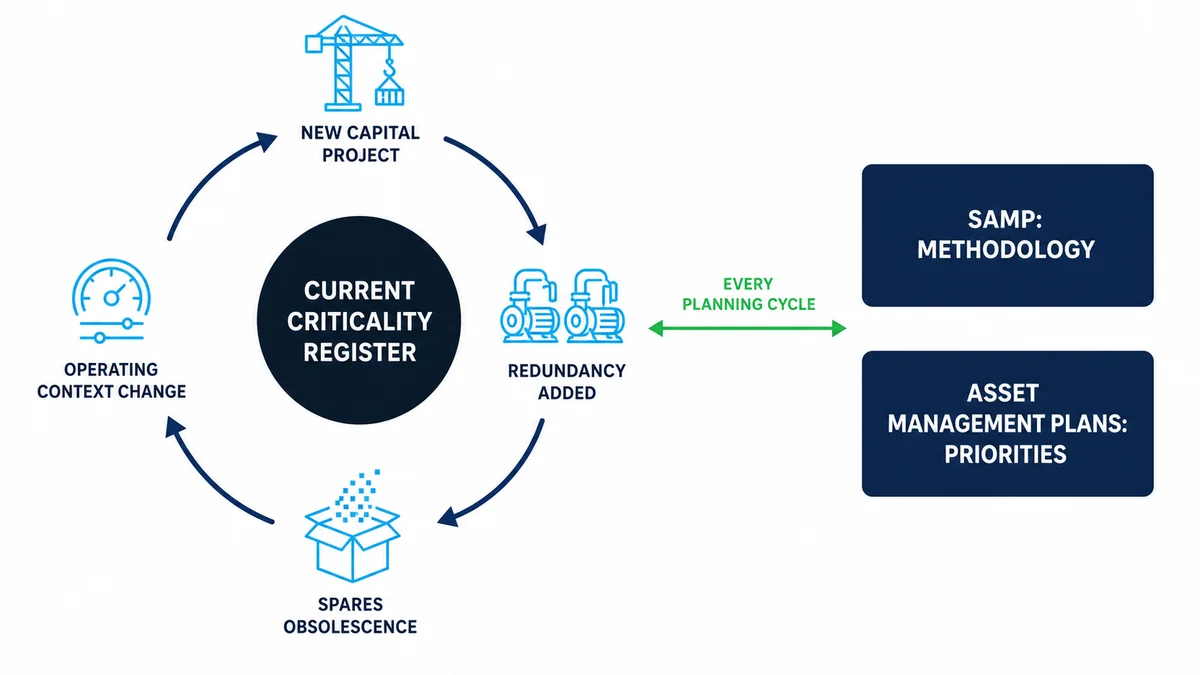
The most common trigger events are worth recognising on sight, because each one changes consequence without any asset failing:
- A new capital project changes the consequence map around it. An expansion or debottlenecking project that lifts throughput changes what every downstream stoppage costs, and assets that sat comfortably in a mid class can move to the highest class the day the new circuit is commissioned. Reassess the surrounding assets as part of the project scope, so the register is right on day one rather than corrected after the first unexpected stoppage.
- Adding redundancy moves criticality the other way. Installing a standby unit or duplicating a line splits the consequence: each individual unit's rating drops while the system's protection improves. The ratings, maintenance strategies and stocking policies of both units are then revisited together, which releases attention and working capital that the old single-unit rating was consuming.
- Spares obsolescence quietly raises criticality. When a manufacturer discontinues a component and the replacement lead time stretches from weeks to many months, the consequence of the same failure grows even though the asset itself has not changed. Obsolescence reviews therefore feed the criticality register directly, and the stocking policy responds: a last-time buy, an engineered alternative or an insurance spare.
Operating context changes belong on the same trigger list: sustained shifts in production rates, product value, contractual commitments or process configuration all move consequence. Give the register a named owner accountable for initiating reviews on these triggers, with assessment leads trained in the methodology and in facilitation. Strategy development and strategy optimisation both begin by confirming the rating is current, because every downstream decision inherits it.
Stewardship and Governance: Criticality in the SAMP, the AMPs and the Boardroom
A criticality register earns trust the same way financial accounts do: through method, ownership and regular review.
The strategic asset management plan is where the methodology lives. The GFMAM Landscape expects the SAMP to record the decision-making criteria and the methodology for determining asset criticality: the consequence dimensions, the severity scales, the likelihood bands, the matrix and the review triggers. Documenting the methodology at SAMP level makes criticality a governed element of the asset management system rather than a local practice, and it guarantees that two sites assessing the same class of asset reach comparable answers the whole organisation can rank capital against.
The asset management plans consume and refresh the ratings. Each AMP draws its priorities from the current register, and each planning cycle begins by confirming the ratings it relies on are still current. Strategy reviews, stocking reviews and capital submissions cite the rating behind them, and when a trigger event changes a rating, the affected plans update with it. This is the loop that keeps plans honest: no plan builds on last year's consequence, and no rating changes without the plans that depend on it hearing about it.
Stewardship completes the picture upward. Management review under ISO 55001 examines whether the register is current and whether its exposures are being managed. Ratings that sit outside risk appetite are escalated with treatment plans, and the board receives assurance built on the same bottom-up roll-up the field works from: a current list of critical assets, the feasible failure modes on each, and the strategy managing every one. Capital stewardship, the obligation to deploy and maintain the asset base responsibly on behalf of owners and stakeholders, becomes demonstrable rather than asserted, because the chain from a component failure mode to a board risk statement is unbroken and auditable.
The Foundation Under Every Defensible Decision
Criticality is not a classification exercise; it is the analytical foundation of prioritisation across the entire asset lifecycle.
Set it first at design, where consequence is cheapest to change. Carry it through operational readiness so operations inherits a working register on day one. Connect it to component failure modes inside a structured hierarchy so consequence rolls up from the field to the boardroom. Let it steer strategy depth, spares, inspection and capital. Move it when capital projects, redundancy and obsolescence move the consequence around it, and govern it through the SAMP and the asset management plans so every level of the business trusts the same picture. With that foundation in place, every prioritisation decision the system makes is defensible.
A practical starting point is a single production system. Align the consequence scales with your corporate risk framework, assess that system's equipment units with a cross-functional team, load the ratings into the CMMS, and let them steer the strategy reviews and stocking decisions for that system. The value becomes visible quickly, and the methodology then scales across the portfolio with a working example behind it.
Related reading: asset management maturity levels in practice and our Data Standardisation and AI Readiness Framework.
Frequently asked questions
What is the difference between asset criticality and risk?
Criticality is a function of the relative importance of an asset or system to the organisation's overall mission, so it is set by what the asset does, where it sits in the process, what redundancy backs it up and what a failure would cost. Risk is a function of that criticality combined with the likelihood of the failure occurring. Criticality is a stable property of the asset; likelihood moves with condition, operating context and the effectiveness of the maintenance strategy.
At what level of the asset hierarchy should criticality be assessed?
At the equipment unit level, the pump, the conveyor, the transformer, the gas turbine, which is Level 6 in the ISO 14224 equipment hierarchy. The maintainable item sits below it at Level 8. Assessing whole plants produces ratings too blunt to steer decisions, and assessing individual components multiplies the effort with no gain in decision quality. Components contribute through their failure modes, which roll up to the equipment rating.
When should an asset first be assessed for criticality?
At the design stage, and at asset level. Design is where consequence is cheapest to change, because adding a standby unit on the drawing board costs a design revision while adding it after commissioning costs capital works, downtime and re-engineering. Operational readiness then carries that early rating into service: every new asset is assessed before handover, initially unmitigated, so the rating drives maintenance strategy development, spares planning and the CMMS build rather than trailing them.
What changes an asset's criticality rating?
Real events change consequence without any asset failing. A new capital project that lifts throughput changes what every downstream stoppage costs. Adding redundancy splits the consequence and lowers each unit's rating. Spares obsolescence quietly raises criticality when a replacement lead time stretches from weeks to many months. Operating context changes belong on the same list: sustained shifts in production rates, product value, contractual commitments or process configuration all move consequence.
What decisions does a criticality rating actually drive?
Maintenance strategy depth first: the highest criticality classes justify full FMECA and RCM analysis, mid classes suit streamlined or template-based development, and the lowest classes are frequently best served by a deliberate, documented run-to-failure decision. The same ratings drive spares stocking, inspection and condition monitoring intensity, and the ranking of renewal and upgrade candidates in the capital plan. At the daily level, the criticality indicator on every work order drives schedule priority and backlog risk ranking.