In brief
- Asset management maturity is a measure of fitness for purpose, not a compliance certificate, and it covers performance and assurance as well as documented process.
- At Level 1 asset decisions are made in response to events rather than in anticipation of them. At Level 2 the governance framework is taking shape but the documents are ahead of the practice.
- Level 3 aligns with conformance to ISO 55001, which the IAM describes as the competent level of maturity rather than the destination.
- At Level 4 asset management is a cross-functional discipline rather than a function inside one department. At Level 5 it is embedded deeply enough to survive management change without regressing.
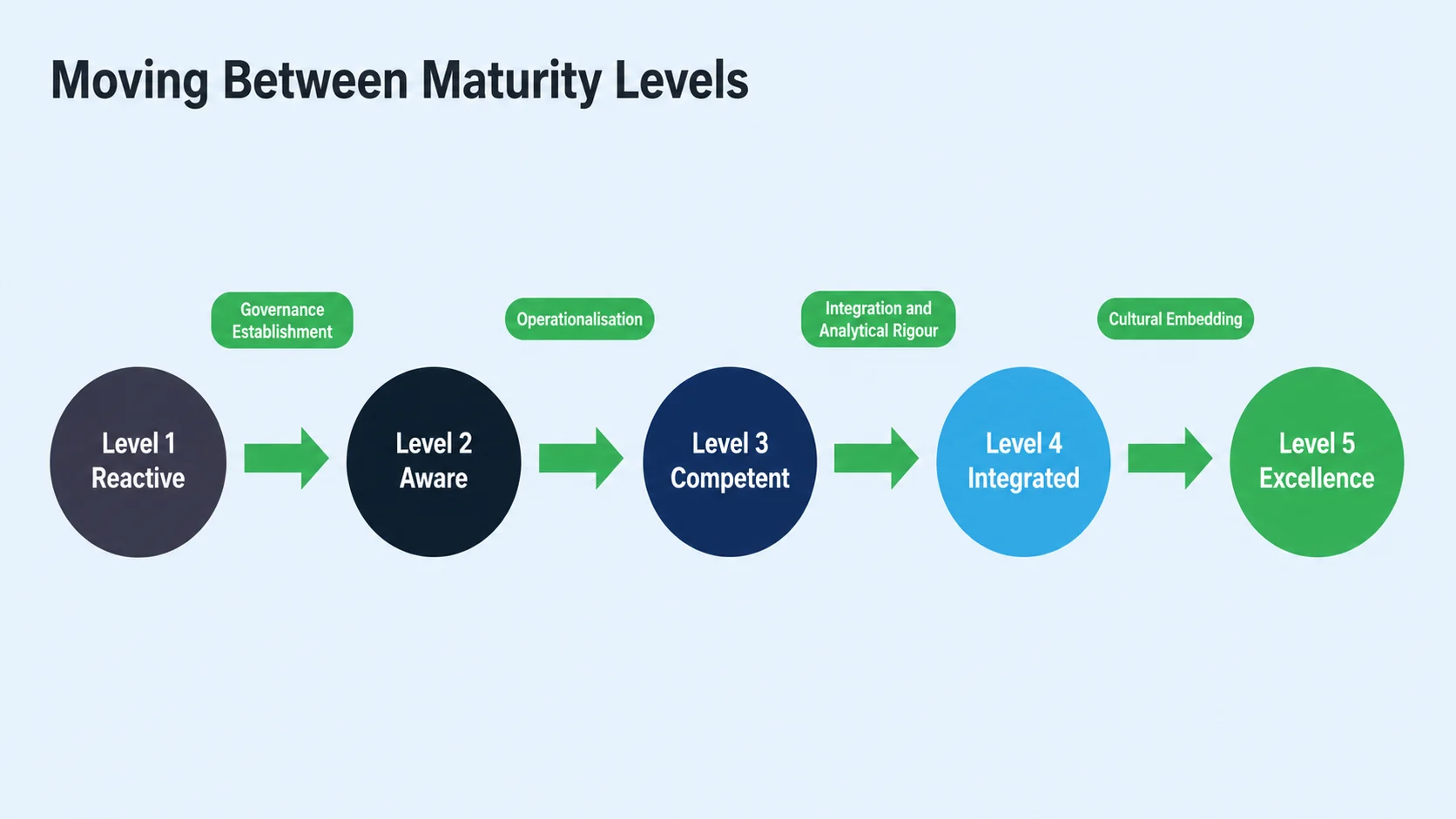
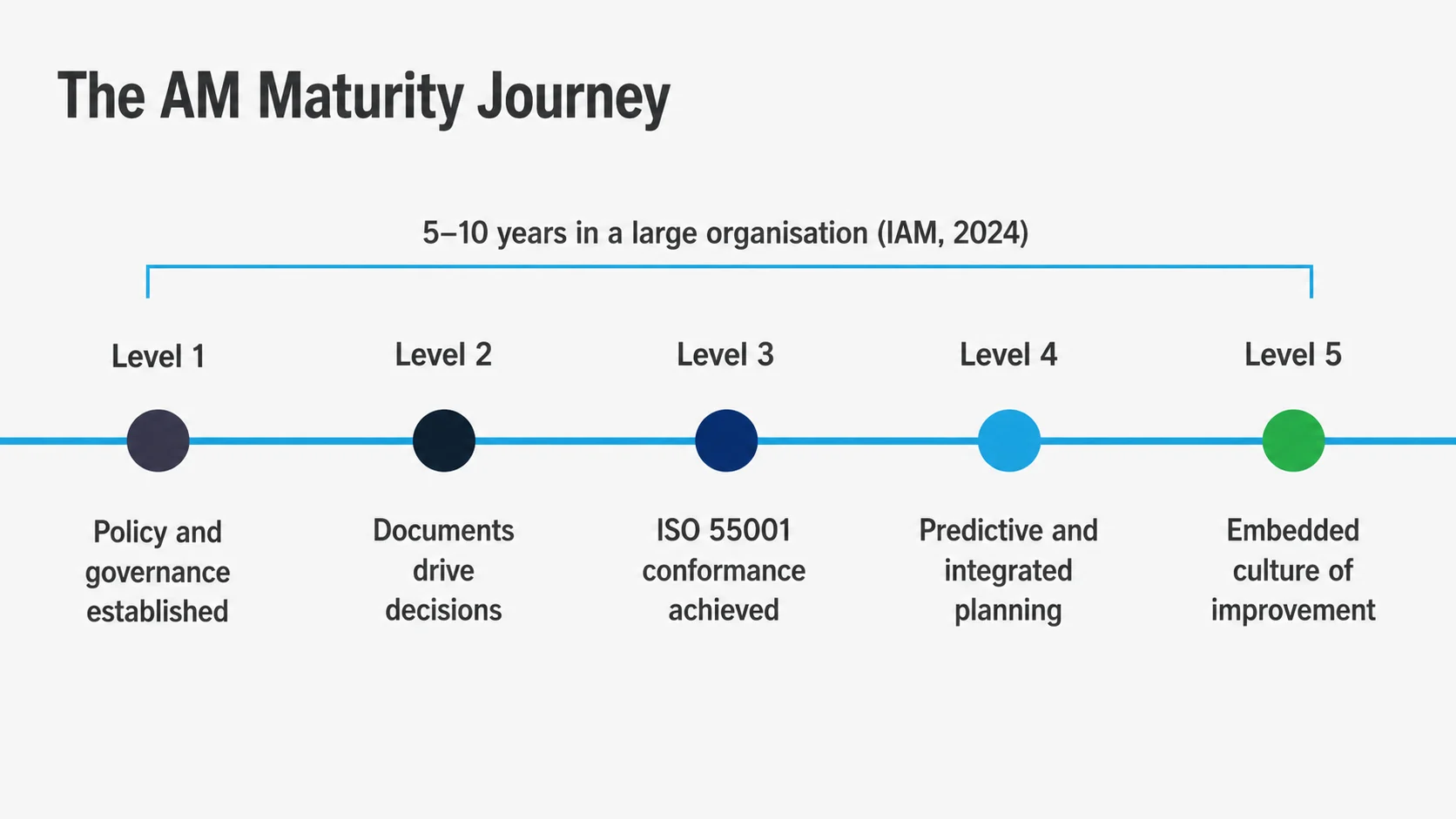
- Each transition demands a different kind of change: governance establishment, then operationalisation, then integration and analytical rigour, then cultural embedding.
Asset management maturity frameworks are widely used and frequently misunderstood. Most describe what an organisation should have at each level. Fewer describe what actually changes inside the organisation when it moves between levels: what decisions get made differently, what data looks like, how planning is conducted, and what the culture of the organisation produces. A maturity framework becomes practically useful when it answers those questions precisely, not when it delivers a score.
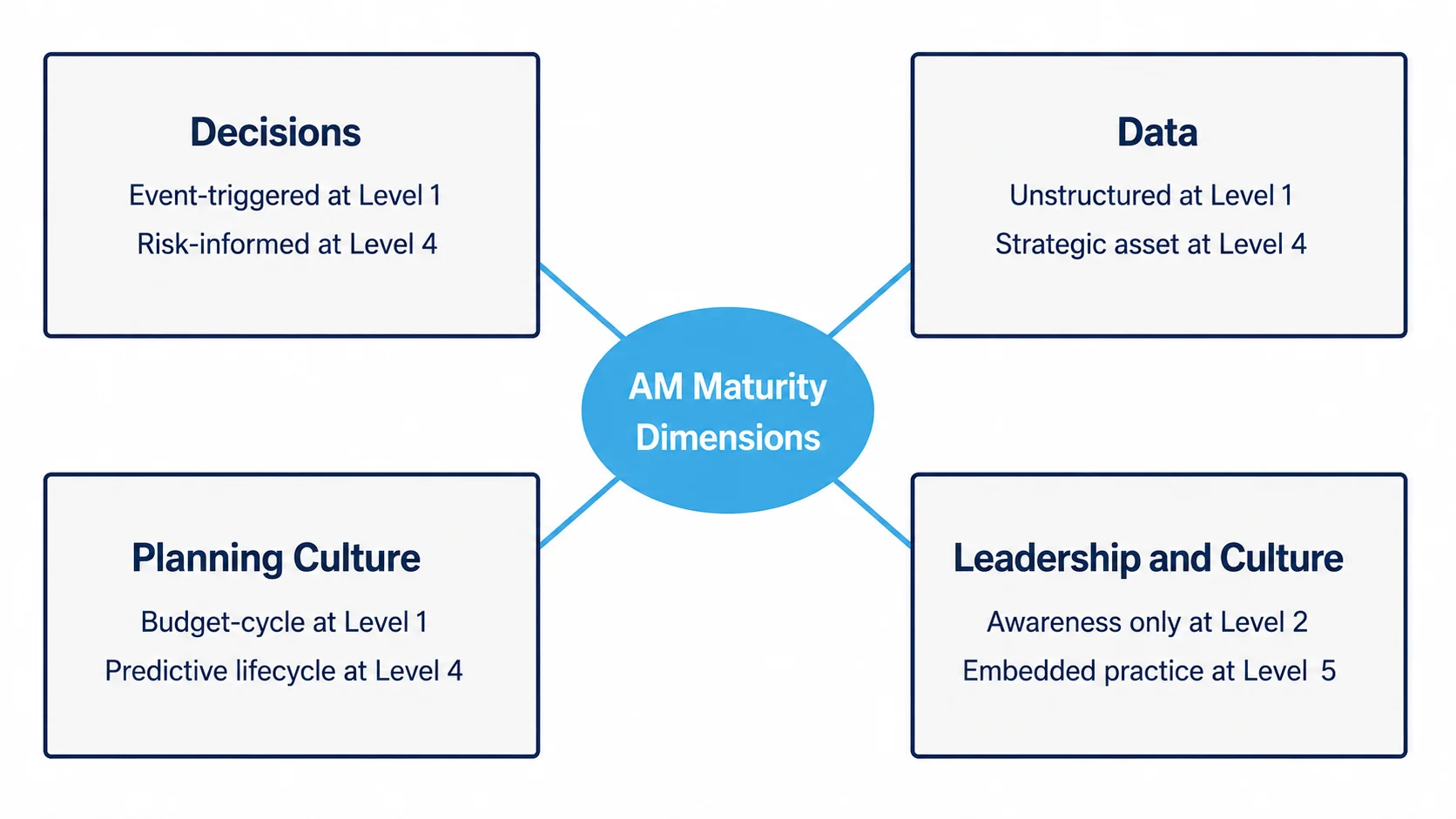
This guide maps each level of the maturity scale to specific, observable behaviours across four dimensions that matter most in practice. It sits here, after the policy, SAMP, and AMP guides, because understanding maturity requires the governance architecture as a reference point. You need to understand what a well-functioning asset management system looks like before you can locate where your organisation sits in relation to it. Readers who have followed the series will find the level descriptions immediately recognisable.
The maturity scale described below aligns with the GFMAM Asset Management Landscape Third Edition (2024) and the IAM's Pathway to Excellence guidance. Terminology and the number of defined levels varies between frameworks; the substance of what each level describes is consistent across them.
What Asset Management Maturity Actually Measures
Maturity is a measure of fitness for purpose, not a compliance certificate.
The GFMAM defines asset management maturity as the extent to which the capabilities, performance, and ongoing assurance of an organisation are fit for purpose to meet the current and future needs of its stakeholders, including the ability of the organisation to anticipate and respond to its operating context. Three points in that definition deserve attention before reading the level descriptions.
First, maturity includes performance, not just process. Having a documented asset management system does not constitute maturity if the system is not producing measurable improvements in asset performance, cost management, and risk control. The documents are necessary but not sufficient.
Second, maturity includes assurance. An organisation that does not formally assess its own system cannot claim to know its maturity position. Assurance closes the loop between what the system intends and what it delivers, and it is a component of every maturity level from Level 3 upward.
Third, maturity includes adaptability. An organisation that manages assets well under stable conditions but cannot respond to a change in demand, a major failure event, or a shift in the regulatory environment is not at a high maturity level regardless of its certification status.
The five levels at a glance
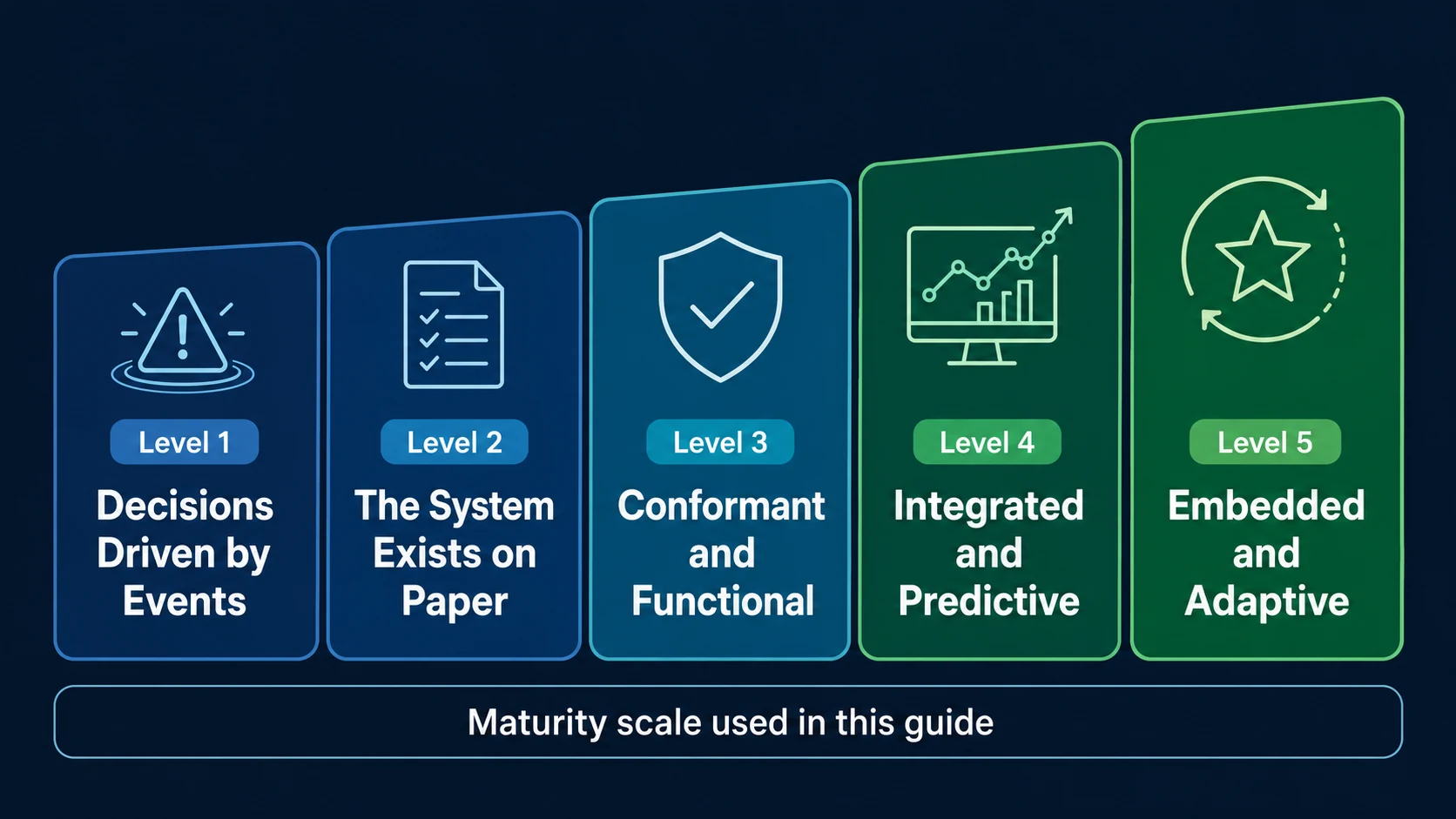
- Level 1Decisions Driven by Events
- Maintenance is triggered by failures, planning is short-horizon and set by the budget cycle, and work order data cannot support meaningful analysis.
- Level 2The System Exists on Paper
- The policy, the SAMP and the AMPs exist or are being developed, but they describe intentions that decisions do not yet consistently follow.
- Level 3Conformant and Functional
- The governance hierarchy is visible in how work gets done, data is reliable enough to support planning, and lifecycle cost modelling informs major renewal decisions.
- Level 4Integrated and Predictive
- Finance, operations, engineering and maintenance plan from a shared framework, and risk-based and predictive methods displace inherited schedules.
- Level 5Embedded and Adaptive
- The systems, culture and decision-making frameworks are embedded deeply enough to sustain themselves through management changes, restructures and operational disruptions.
Level 1: Decisions Driven by Events
At the first maturity level, asset decisions are made in response to events, not in anticipation of them.
Maintenance is triggered by failures. Inspections happen when a regulator requires them or when an incident makes them unavoidable. Capital replacement is initiated when an asset stops working or becomes an imminent safety liability. The question asked before most maintenance activity is whether the budget can accommodate it, not what the asset actually needs across its life and at what point the investment makes sense.
Planning exists but is short-horizon and reactive. Budget cycles are the primary planning instrument. There is no articulated SAMP, and there are no AMPs that connect asset decisions to organisational objectives. The governance framework that the preceding guides describe either does not exist or is aspirational rather than functional.
Data at this level is characteristically unstructured. Work orders are logged, but failure codes are absent or applied inconsistently, and the historical records cannot support meaningful analysis of failure patterns, maintenance cost trends, or asset condition trajectories. The asset register, if it exists, may not reflect current asset status.
From a financial perspective, maintenance cost as a percentage of replacement asset value (RAV) at this level tends to be high and variable. Production loss from unplanned downtime is the primary cost driver, and it is often not quantified with enough precision to make the business case for proactive investment.
The gap to Level 2 is governance. The organisation needs to establish the policy commitment, build the governance structure, and begin documenting its approach to asset management with enough specificity that it can be assessed and improved.
Level 2: The System Exists on Paper
At Level 2, the governance framework is taking shape, but the documents are ahead of the practice.
An asset management policy has been written and endorsed. A SAMP exists or is being developed. There are AMPs, or at least maintenance strategies and schedules that approximate what AMPs should deliver. ISO 55001 implementation is underway or being planned. The organisation recognises asset management as a discipline and has invested in establishing its foundations.
The characteristic challenge at this level is that governance documents describe intentions that are not yet consistently reflected in how decisions are made. The policy is signed but not fully understood across the organisation. The SAMP contains objectives, but decisions at the operational level are still made without reference to them. The AMPs describe planned activities, but the connection between each activity and a specific objective, consequence of deviation, or performance standard is not yet established in practice.
Data is improving. An asset register is in place, though it may be incomplete. Some failure coding exists in the CMMS, but free-text descriptions are still common, and the data quality is insufficient for rigorous reliability analysis. Maintenance cost is tracked but lifecycle cost thinking is not yet embedded in capital decision-making.
The gap to Level 3 is operationalisation. The governance documents must drive decisions, not just describe intentions. Until the framework produces observable changes in how work is planned, how capital is prioritised, and how performance is reviewed, the organisation remains at Level 2 regardless of how many policies are on the register.
Level 3: Conformant and Functional
Level 3 aligns with conformance to ISO 55001, but the certificate alone does not confirm Level 3 maturity. (This five-level asset management maturity scale, aligned with the GFMAM Landscape and the IAM Pathway to Excellence, is not the same as the four-level certification-to-maturity progression set out in our ISO 55001 guide, which places the same ISO 55001 conformance milestone at its Level 1 rather than Level 3, so a level number on one scale does not correspond to the same number on the other.)
The distinction is whether the management system is producing genuine governance of asset decisions. Organisations that achieve ISO 55001 certification through documented procedures that are not consistently applied in practice have the certificate without the system. At a functional Level 3, the governance hierarchy is visible in how work actually gets done: decisions at every level trace back to the SAMP and the AMPs, and the SAMP itself is a living document reviewed when organisational objectives change.
Data at this level is reliable enough to support planning. Failure coding is structured and applied consistently. The asset register is accurate and maintained. Maintenance history is sufficient to identify failure patterns, support interval optimisation, and inform capital decisions. TOTEX, total expenditure combining CAPEX and OPEX across the full planning horizon, is applied to major renewal and replacement decisions, and lifecycle cost modelling is used to compare options before capital commitment.
The financial markers at Level 3 are clear. CAPEX budget cycles are aligned to lifecycle plans rather than constructed from annual estimates. OPEX is tracked against asset-specific performance standards. Return on assets (ROA) is considered in portfolio-level investment decisions. The organisation is beginning to shift from managing assets by year to managing assets by life.
The IAM is explicit that ISO 55001 conformance represents the "competent" level of maturity, not the destination. It describes a functioning management system. The higher maturity levels describe how deeply that system is integrated into organisational decision-making and culture.
The gap to Level 4 is integration. Functions that have managed their own data and made decisions within their own boundaries need to begin working from shared information, shared risk frameworks, and shared objectives. Risk-based methods need to start displacing calendar-based defaults in maintenance strategy.
Level 4: Integrated and Predictive
At Level 4, asset management is a cross-functional discipline, not a function sitting within one department.
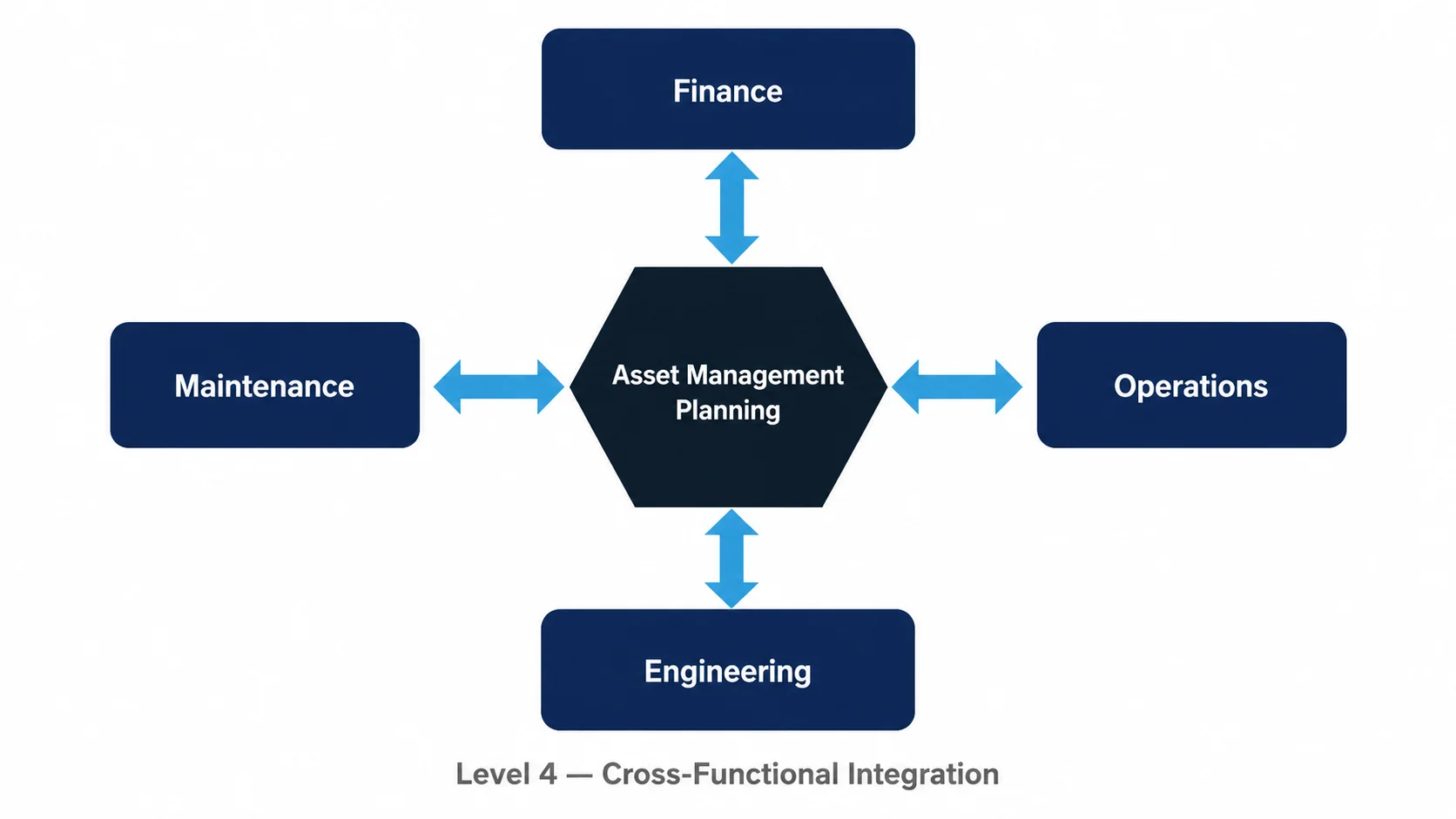
Finance, operations, engineering, and maintenance plan together from a shared framework. Capital decisions are built from lifecycle cost models that all contributing functions understand and have input into. Risk-based prioritisation is consistently applied, and the outputs of criticality analysis are visible in both maintenance scheduling and capital programming.
The planning culture at this level is proactive and predictive. Maintenance strategies are built from FMECA or RCM analysis rather than inherited schedules. Condition monitoring and predictive tools are deployed on critical assets, and the data they generate feeds maintenance scheduling in near-real-time. Calendar-based preventive maintenance still exists for failure modes where time-based intervention is analytically appropriate, but it is justified rather than assumed.
Data at Level 4 is a strategic resource. Failure history, condition data, and maintenance cost records are used to optimise intervals, refine criticality rankings, and build lifecycle cost models that drive capital programming. Overall equipment effectiveness (OEE) is tracked at the system level, and production loss from unplanned downtime is quantified in dollars per hour. The CMMS is configured with structured failure code hierarchies that allow meaningful analysis: failure mode frequency, cost by failure cause, and trend-based interval review.
The financial outcomes at Level 4 are measurable. ROA improves as capital is directed to decisions that generate the greatest value rather than the decisions that generated the most reactive pressure. Maintenance cost as a percentage of RAV begins to fall into the well-managed benchmark range: approximately 2 to 4 per cent for continuous process assets, or 4 to 7 per cent for heavy asset industry environments such as mining and minerals processing, as reactive spend is displaced by planned activity. Deferred maintenance liabilities are tracked, quantified, and managed as a financial risk rather than simply a maintenance backlog.
Level 5: Embedded and Adaptive
At the highest maturity level, asset management is not something the organisation does, it is how the organisation works.
The distinction matters because it describes sustainability. At Level 5, the systems, culture, and decision-making frameworks are sufficiently embedded that they sustain themselves through management changes, restructures, and operational disruptions without regressing. A new operations manager or a change in the capital allocation process does not unwind years of capability development because the capability is embedded in how people at every level think about assets, not only in the documents that describe the system.
Continual improvement at this level is not a programme with a start and end date. It is a built-in capability. Asset performance data, failure analysis, and value realisation metrics continuously feed improvements back into the governance framework. The SAMP and AMPs are updated as learning accumulates. Assurance mechanisms such as internal audit, peer review and benchmarking are conducted as a matter of course, not as preparation for external certification.
The board and executive team at Level 5 are active participants in asset management governance. Capital stewardship, the board's obligation to deploy and maintain the asset base on behalf of stakeholders efficiently and sustainably, is exercised through regular review of asset management performance against the SAMP objectives. ESG obligations are managed partly through the asset management system, and the connection between lifecycle decisions and long-term organisational resilience is understood at governance level, not only at operational level.
The IAM notes that what constitutes excellence is context-dependent and continues to evolve. An organisation that achieved embedded Level 5 practice a decade ago is not static; the leading edge moves, and sustained excellence requires ongoing adaptation. In a large organisation, reaching this level of embedded practice typically takes between five and ten years from the point of serious, cross-functional commitment.
What the Gap Between Levels Requires
Each transition in the maturity scale demands a different kind of change.
Moving from Level 1 to Level 2 requires governance establishment. The organisation must put the policy, the governance structure, and the foundational documents in place. This is primarily a leadership decision: it requires executive endorsement and a commitment of management time to build the framework.
Moving from Level 2 to Level 3 requires operationalisation. Every element of the governance framework must begin producing observable changes in how decisions are made at the operational level. The challenge here is not technical; it is cultural and organisational. Getting the SAMP to drive capital decisions requires finance, engineering, and maintenance to plan from the same horizon and the same risk framework. This is where most of the effort in AM system implementation falls.
Moving from Level 3 to Level 4 requires integration and analytical rigour. Functions that have operated with separate workflows, separate data standards, and separate decision criteria must build shared processes. Risk-based maintenance strategy must replace calendar defaults where the analysis supports it. Predictive capability must be deployed where the criticality and consequence of failure justify the investment. This transition is operationally intensive and requires change management as much as technical implementation.
Moving from Level 4 to Level 5 requires cultural embedding. The governance framework must survive personnel changes, budget pressures, and competing priorities without regressing to earlier behaviours. This is sustained through leadership behaviours at every level, performance measurement against published objectives, and an organisational culture that treats learning from asset performance as a core operating discipline rather than a periodic review activity.
How to Use a Maturity Assessment
A maturity assessment is most useful when it produces a sequenced improvement plan, not a score.
The score tells an organisation where it is. The improvement plan tells it what to work on next and in what order. Effective assessments cover all 40 subjects of the GFMAM Asset Management Landscape, not only the ISO 55001 requirements. An organisation can achieve ISO 55001 conformance while carrying significant gaps in supply chain management, knowledge management, demand analysis, or lifecycle value realisation. A full-scope assessment reveals those gaps and allows improvement effort to be allocated where it generates the most value.
Third-party assessment against a structured framework, such as the IAM's SAM+ tool or equivalent tools developed by GFMAM member societies, provides an independent perspective that internal self-assessment cannot replicate. The most valuable output of any maturity assessment is not the current-state rating; it is the gap analysis and the sequenced improvement programme that follows from it.
Maturity assessment also provides a benchmarking mechanism. Organisations that understand their maturity position relative to industry peers are better placed to make the internal case for the investment required to advance capability and to demonstrate to regulators, investors, and counterparties that asset management is being taken seriously as an organisational governance obligation.
Maturity as a Practical Planning Instrument
Asset management maturity is not a target to achieve and then maintain. It is a description of where an organisation currently sits in its capability development, and a reliable guide to what the next improvement effort should focus on.
Every governance element covered in this series, from the policy through the SAMP to the AMPs, has a maturity dimension. A policy that governs decisions sits at a higher maturity level than one that satisfies an audit. A SAMP that drives planning across the lifecycle sits at a higher maturity level than one that documents objectives without connecting them to how capital is allocated. Understanding maturity means understanding the quality of the system you have built, and the specific changes that would make it more effective.
The progression from Level 1 to Level 5 is not linear in practice. Organisations improve faster in some areas than others, encounter organisational resistance at particular transitions, and sometimes build strong operational capability without the governance architecture to sustain it. Knowing where each dimension of the system sits is the starting point for a credible improvement plan.
Frequently asked questions
What does asset management maturity actually measure?
Maturity is a measure of fitness for purpose, not a compliance certificate. The GFMAM defines asset management maturity as the extent to which the capabilities, performance and ongoing assurance of an organisation are fit for purpose to meet the current and future needs of its stakeholders, including the ability of the organisation to anticipate and respond to its operating context. It therefore includes performance rather than process alone, includes assurance, and includes adaptability.
Does ISO 55001 certification mean an organisation is at Level 3 maturity?
Not on its own. Level 3 aligns with conformance to ISO 55001, but the certificate alone does not confirm Level 3 maturity. Organisations that achieve certification through documented procedures that are not consistently applied in practice have the certificate without the system. At a functional Level 3 the governance hierarchy is visible in how work actually gets done, decisions at every level trace back to the SAMP and the asset management plans, and the SAMP is reviewed when organisational objectives change.
Which transition between maturity levels is the hardest?
Each transition demands a different kind of change. Moving from Level 2 to Level 3 requires operationalisation, and this is where most of the effort in asset management system implementation falls, because getting the SAMP to drive capital decisions requires finance, engineering and maintenance to plan from the same horizon and the same risk framework. Moving from Level 3 to Level 4 requires integration and analytical rigour, and that transition is operationally intensive and requires change management as much as technical implementation.
How long does it take to reach the highest maturity level?
In a large organisation, reaching embedded Level 5 practice typically takes between five and ten years from the point of serious, cross-functional commitment. The IAM also notes that what constitutes excellence is context-dependent and continues to evolve, so an organisation that reached embedded practice a decade ago is not static and sustained excellence requires ongoing adaptation.
What should a maturity assessment produce?
A sequenced improvement plan, not a score. The score tells an organisation where it is; the improvement plan tells it what to work on next and in what order. Effective assessments cover all 40 subjects of the GFMAM Asset Management Landscape rather than only the ISO 55001 requirements, because an organisation can achieve ISO 55001 conformance while carrying significant gaps in areas such as supply chain management, knowledge management, demand analysis or lifecycle value realisation.