In brief
- An asset management system is a governance architecture. It is not software, not a department and not a maintenance programme.
- It governs lifecycle decisions from planning and acquisition through operation, maintenance, renewal and disposal, with early decisions shaping later cost, performance and risk.
- ISO 55001:2024 is the certifiable requirements standard for that system, with its requirements structured across ten clauses.
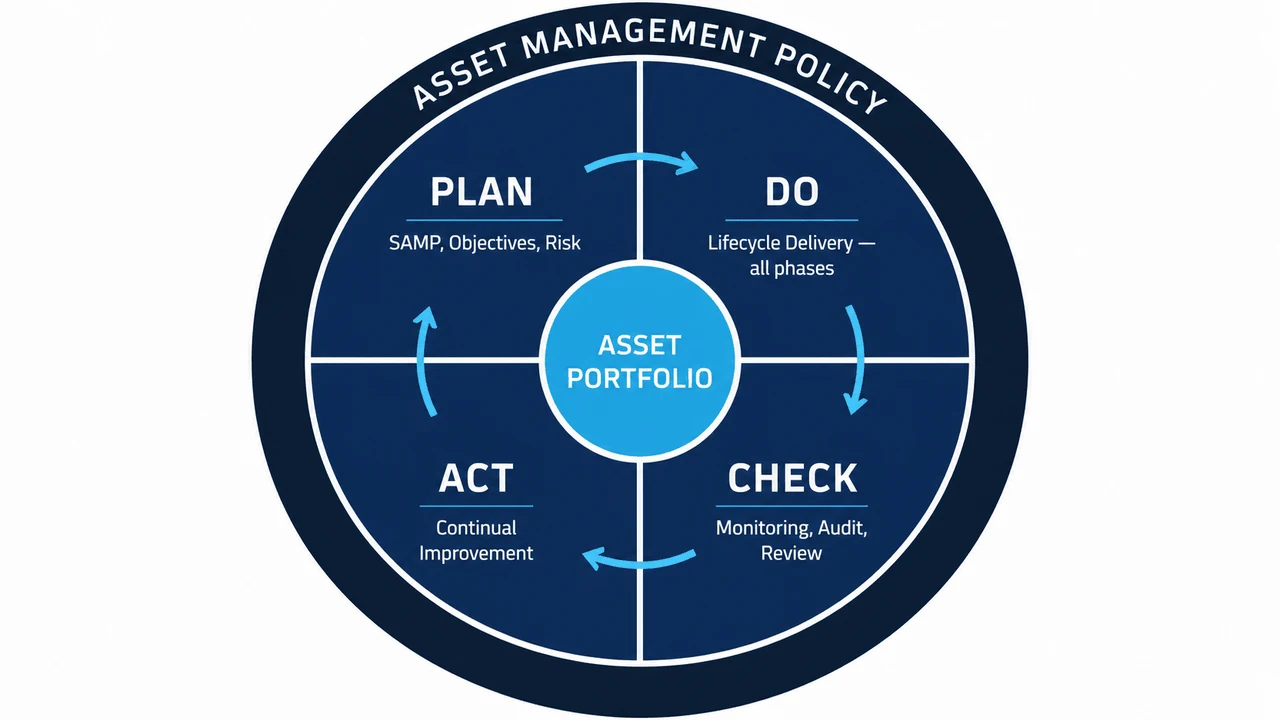
- A decision cascade carries direction down from the asset management policy through the SAMP, the asset management plans and operational plans to daily work, and carries performance information back up.
The engineer who specifies an asset during planning may never sit with the engineer who operates it fifteen years later. The project team that commissions a new facility and hands it over may leave behind documentation that does not reflect what the operations team will actually need to run it. The manager who approves a capital investment may never see how that asset performs against the assumptions that justified the spend. Each group does its job. The system that should connect them often does not exist.
An asset management system is that connecting structure. It is the framework through which an organisation governs its physical assets in a coordinated, evidence based way from the first decision to invest in an asset to the final decision to retire it. It connects strategy to activity, planning to delivery, and performance outcomes back to the objectives that were set. This guide explains what that system is, what it requires and why it matters to every engineer and manager who works with physical assets regardless of the lifecycle stage they work within.
What an Asset Management System Is
ISO 55000:2024 is the international standard that defines the vocabulary and foundational concepts for the asset management discipline. Two definitions from that standard are the starting point for understanding what an asset management system is and what it does.
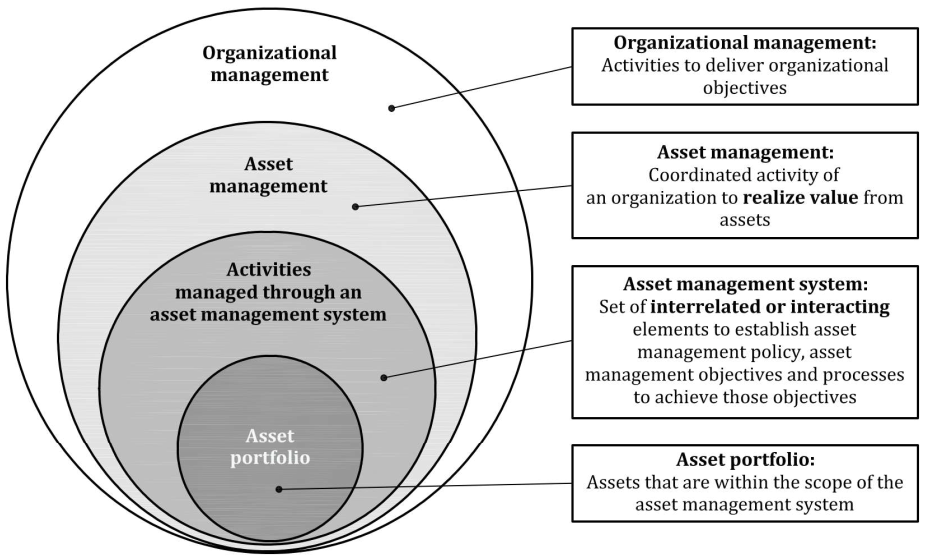
Two things follow from the definitions of "asset management" and "asset management system". First, asset management is defined as coordinated activity. The emphasis is on coordination across the whole organisation, not technical excellence within a single function or a single lifecycle stage. Second, the purpose of asset management is to realise value from assets. Value is defined in terms of what the organisation needs from its assets: service delivery, financial return, risk reduction, regulatory compliance or a combination of these, depending on the nature of the organisation and its context.
An asset management system is the structure that makes coordinated, value focused asset management possible at an organisational scale. It is a management system in the same formal sense as a quality management system or an environmental management system: a set of documented policies, objectives, processes and accountabilities that together produce consistent, governed and auditable outcomes. It is not software, not a department and not a maintenance programme. It is a governance architecture.
Asset Management as a Discipline: The Full Scope
Asset management as a formal discipline is broader than any single function, department or lifecycle stage. The Global Forum on Maintenance and Asset Management published its Asset Management Landscape Third Edition in 2024, mapping the discipline across 40 subject areas organised into seven groups.
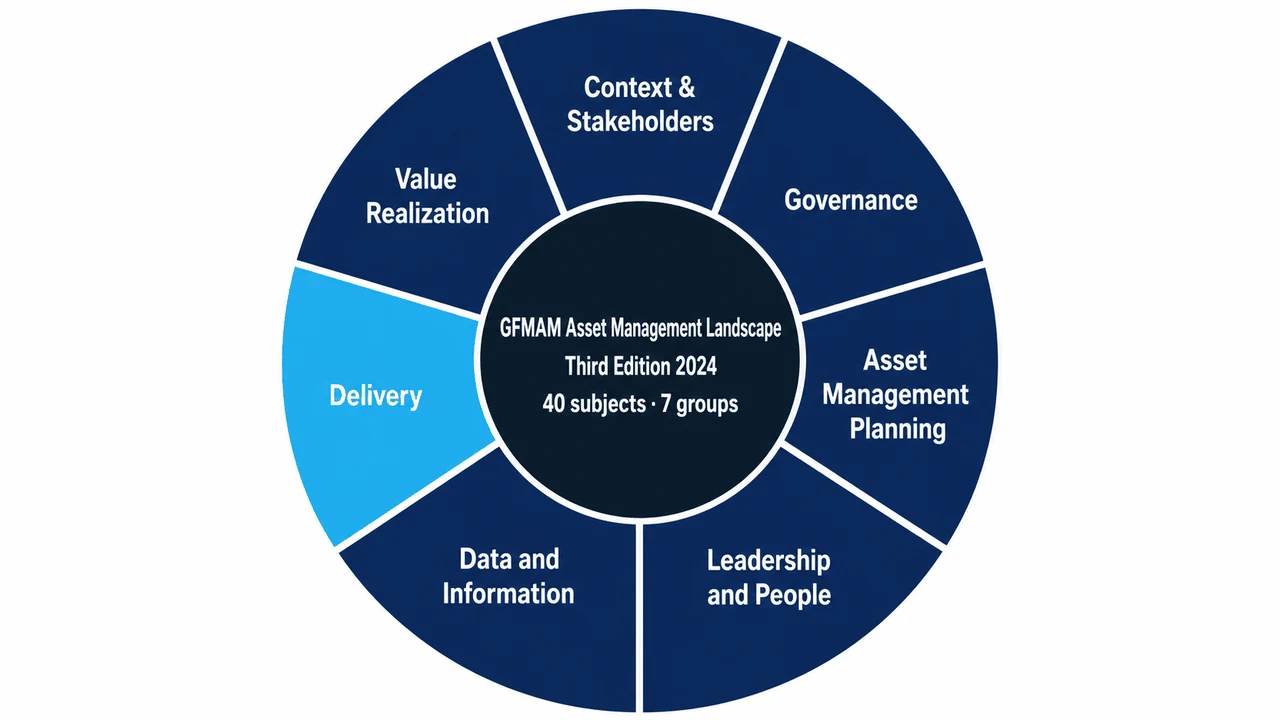
- 01 Context & Stakeholders: Organisational context, stakeholder needs and expectations, and the defined scope of the asset management system
- 02 Governance: Asset management policy, leadership commitment, roles, accountabilities and the governance and assurance framework
- 03 Asset Management Planning: Strategy, the SAMP, objectives, decision making and the asset management plans that turn intent into action
- 04 Leadership and People: Competency, culture, organisational structure, communication and the behaviours that make the system function
- 05 Data and Information: Asset registers, condition and performance data, knowledge management and the supporting information systems
- 06 Delivery: Lifecycle delivery across every phase, from acquisition and operation through maintenance, renewal and disposal
- 07 Value Realization: Performance monitoring, risk, review, continual improvement and the financial and non-financial value assets deliver
The Asset Lifecycle: Decision Quality at Every Stage
This article uses seven practical lifecycle phases to examine decision quality from planning through disposal. Organisations may group the phases differently, and operation and maintenance are closely integrated during service. The quality of decisions at each point shapes the performance, cost and risk that later stages must manage. The asset management system does not execute those decisions, but it provides the objectives, information, approved risk criteria and accountability within which they are made.
` is parsed as an empty attribute expression, not a comment. Comments must sit OUTSIDE the element, as this one now does. */}
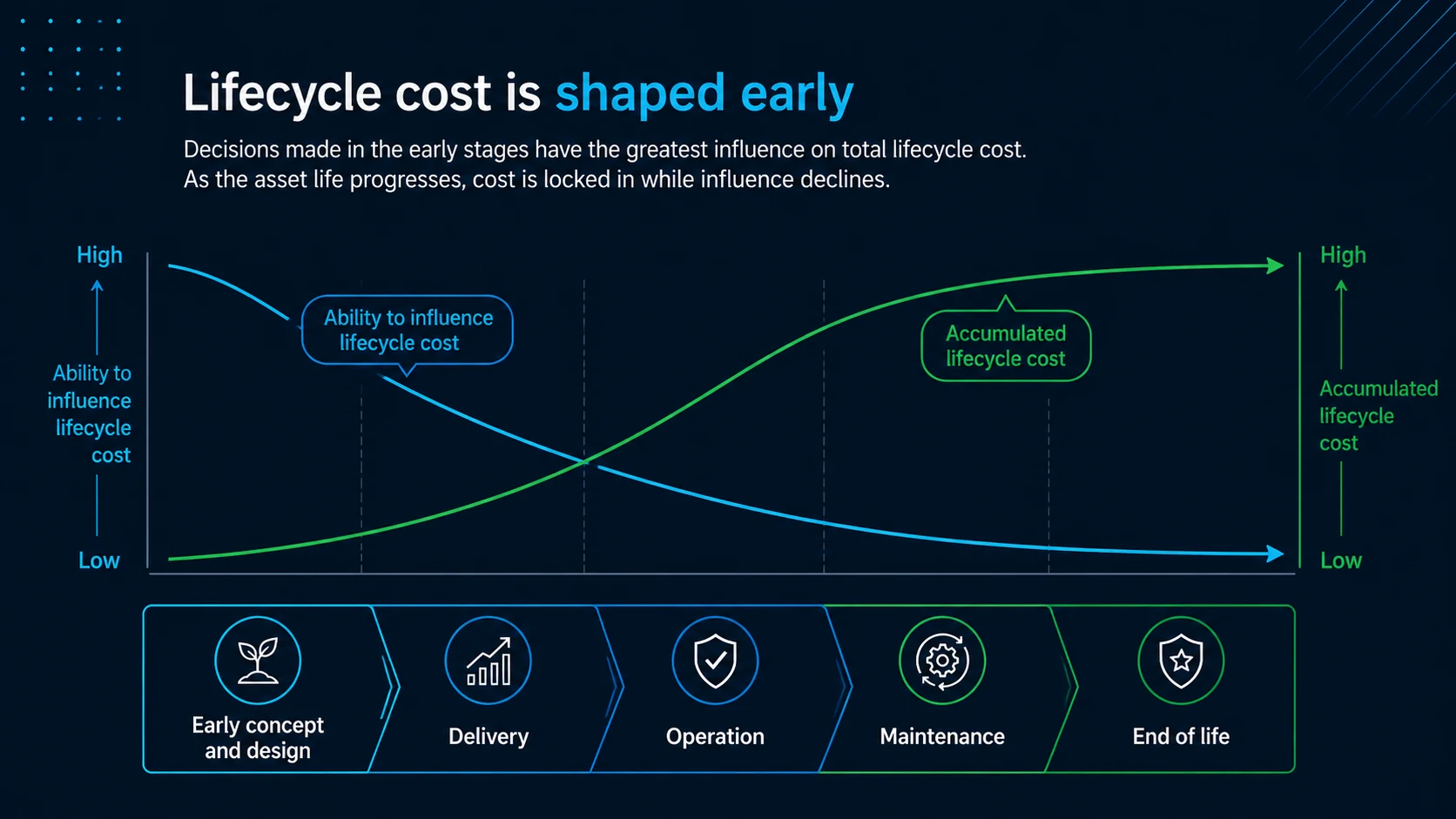
Planning and acquisition decisions establish requirements and constraints that every subsequent lifecycle stage must manage. That makes operational input, lifecycle cost analysis, maintainability and risk evaluation most valuable before the solution is locked in.
The seven phases at a glance
- Phase 01Planning
- What assets are needed, to what performance standard and with what design life?
- Phase 02Acquisition / Creation
- What specification satisfies the full lifecycle requirement at the lowest total cost?
- Phase 03Commissioning
- What is the validated performance baseline all future performance will be measured against?
- Phase 04Operation
- What operating regime sustains the intended function at an acceptable cost and risk?
- Phase 05Maintenance
- What strategy manages deterioration and risk to the levels the objectives require?
- Phase 06Renewal / Modification
- On the available evidence, is repair, refurbishment, upgrade or replacement the optimal decision?
- Phase 07Disposal / Decommissioning
- When and how should the asset exit service, and what must its data record preserve?
01 Planning
Planning is where the lifecycle begins. The organisation determines what assets it needs, to what performance standard, with what design life and at what total lifecycle cost. The decisions made at this stage establish the cost and capability baseline for everything that follows. A well governed planning process depends on the asset management system providing current asset information, portfolio level risk data and strategic objectives that are clearly expressed and measurable.
02 Acquisition / Creation
The asset is specified, procured or constructed at this stage. Requirements, design choices, contracting decisions and information standards established here can constrain cost, performance, maintainability and risk throughout service. An asset management system addresses this by bringing lifecycle cost analysis, operational and maintenance input, asset information requirements and risk evaluation into specification and procurement rather than waiting until after commissioning.
03 Commissioning
The asset is brought into service and validated against its design intent. The quality of commissioning determines the accuracy of the performance baseline against which all future performance will be measured. Incomplete functional testing, poor data capture or inadequate documentation handover at this stage create information gaps that persist for the life of the asset and compromise every subsequent decision that depends on that data.
04 Operation
The asset delivers the function it was acquired to provide. Operating strategies, load management, performance monitoring and condition surveillance all fall within this phase. How an asset is operated, the stresses it is placed under and the duty cycles it is run to directly determine how quickly it degrades and what its cost and risk profile becomes across its remaining life. The asset management system defines the operating envelope and the performance standards the asset is expected to meet.
05 Maintenance
The organisation applies strategies to sustain asset performance, manage deterioration and prevent or respond to failure. Maintenance plans, inspection programmes, condition based strategies and work management systems operate within this phase. These activities are part of what the asset management system coordinates and connects back to the strategic objectives and risk framework that govern the portfolio.
06 Renewal / Modification
The organisation evaluates whether the asset should be repaired, refurbished, upgraded or replaced. These decisions are among the most capital intensive in the asset lifecycle. An asset with poor condition history, incomplete maintenance records and no lifecycle cost baseline is significantly harder to evaluate on a sound and defensible basis. The asset management system builds the information base that makes renewal decisions evidence based and transparent.
07 Disposal / Decommissioning
The asset exits service. This phase involves regulatory obligations, safety management, material and environmental requirements, data archiving and the financial settlement of the asset. It also initiates the planning cycle for whatever replaces the function the retired asset provided. The asset management system ensures the data and lessons from the retiring asset inform the next investment decision rather than being lost.
The Decision Cascade: Connecting Strategy to Activity
One of the most common structural weaknesses in asset management practice is the gap between strategic intent and operational activity. An organisation may have a clearly stated policy and a set of measurable objectives, but if no documented pathway connects those objectives to the work being done across the asset portfolio each day, the policy is a statement rather than a system.
An asset management system addresses this through a formal hierarchy of plans. ISO 55001:2024 requires the organisation to establish a Strategic Asset Management Plan that translates the policy into strategic direction and asset management objectives. Below the SAMP, asset management plans are developed for each asset class or system, specifying how those objectives will be achieved across the portfolio. Below those, operational plans govern how delivery occurs at each lifecycle stage: capital programmes, maintenance strategies, inspection schedules, commissioning plans, operating procedures and decommissioning plans. At the operational level, individual work activities are executed against those plans.
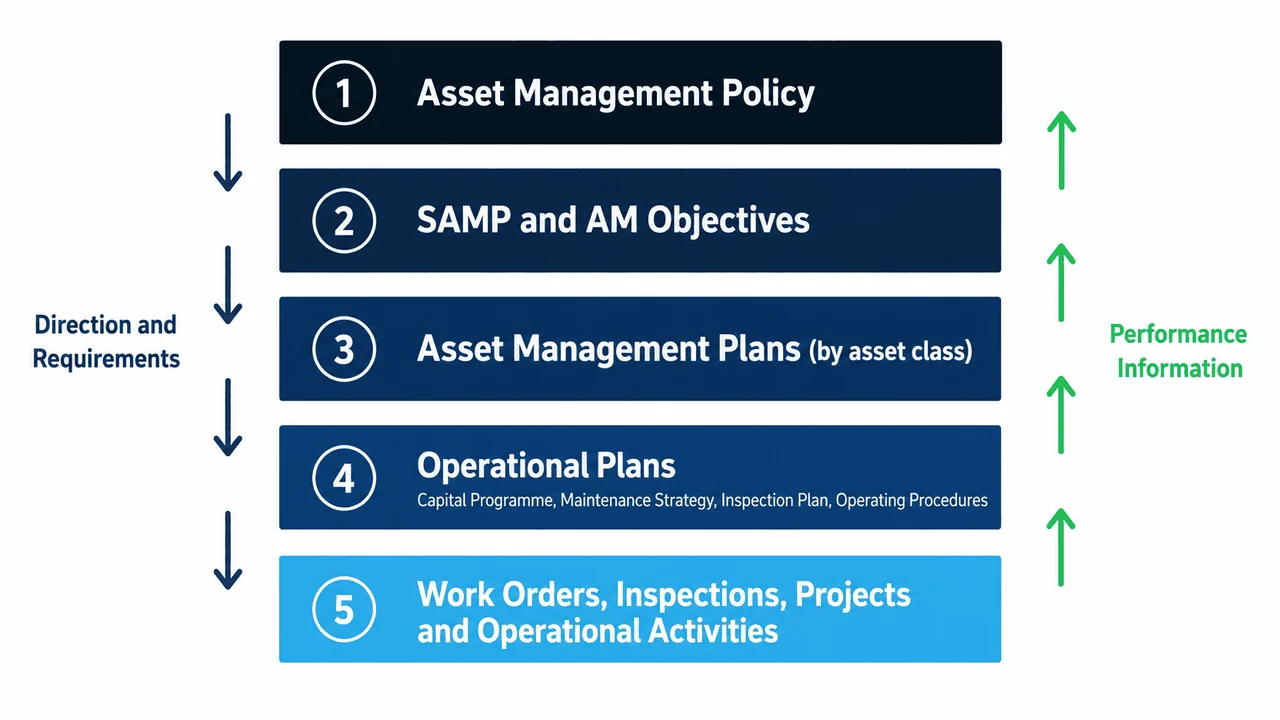
This cascade operates in both directions. Direction and requirements flow downward from policy through to daily activity. Performance information flows upward from operational outcomes through management review, informing whether the strategy is producing the intended results and where it needs to be adjusted.
What ISO 55001 Actually Requires
ISO 55001:2024 is the certifiable requirements standard for an asset management system. It specifies what an organisation must establish, implement, maintain and continually improve. The requirements are structured across ten clauses. Understanding what each clause requires in practical terms shows what the organisation needs to build and how each element connects across the lifecycle.
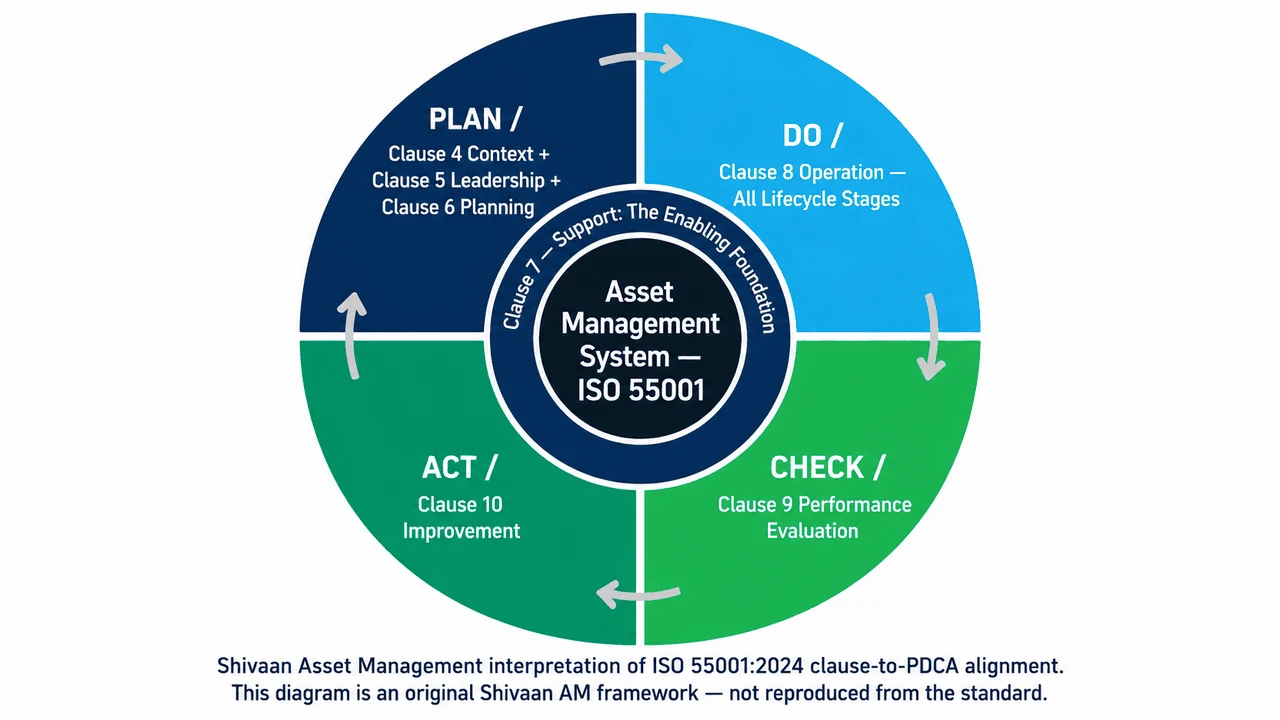
Clauses 4 to 10 at a glance
- Clause 4Context of the Organisation
- Identify the assets under management, understand what stakeholders require from those assets, and define the scope of the system.
- Clause 5Leadership
- Establish an asset management policy endorsed by top management, defining the accountability structure and the commitment to realising value from assets.
- Clause 6Planning
- Establish the Strategic Asset Management Plan connecting policy to measurable objectives, develop the asset management plans beneath it, and apply a structured approach to managing risk.
- Clause 7Support
- Put the resources, competency and documented information the system needs in place, and retain critical asset knowledge in the organisation rather than only in individuals.
- Clause 8Operation
- Govern implementation of the asset management plans across every lifecycle stage, from capital project delivery through to decommissioning.
- Clause 9Performance Evaluation
- Monitor and measure performance against the asset management objectives, audit at planned intervals, and carry out management reviews.
- Clause 10Improvement
- Identify nonconformities, analyse root causes, implement corrective actions, and demonstrably improve the system over time.
Clause 4: Context of the Organisation
Identify the assets under management, understand what stakeholders require from those assets, determine the internal and external factors affecting the ability to achieve objectives, and define the scope of the system. Practical outputs: a documented asset inventory or register, stakeholder analysis, and a scope statement specifying which assets and which lifecycle phases the system governs.
Clause 5: Leadership
The asset management policy must be established and endorsed by top management, defining the accountability structure and expressing the commitment to realising value from assets. Without active leadership engagement, the remaining clauses have no governance foundation and the system cannot function as intended.
Clause 6: Planning
Establish the Strategic Asset Management Plan connecting policy to measurable objectives. Develop asset management plans specifying how each objective will be achieved across the portfolio. Apply a structured approach to managing risk: risks arising from the assets themselves, from organisational capability gaps and from changes in the operating environment.
Clause 7: Support
Ensure the resources, competency and documented information needed to operate the system are in place across every function involved in asset management decisions. Knowledge management processes must retain critical asset information and decision rationale within the organisation, not only within individuals.
Clause 8: Operation
Govern implementation of asset management plans across every lifecycle stage: capital project delivery, commissioning control, operational management, maintenance execution, management of change, outsourcing and decommissioning. This is where the governance architecture of the system meets the physical reality of the asset portfolio.
Clause 9: Performance Evaluation
Monitor and measure performance against asset management objectives, conduct internal audits at planned intervals and carry out management reviews. This feedback mechanism confirms whether the system is producing the outcomes it was designed to produce and whether those outcomes align with the strategic objectives set at the planning stage.
Clause 10: Improvement
Identify nonconformities, analyse root causes and implement corrective actions. The system must demonstrably improve over time. An organisation that implements ISO 55001 requirements and then leaves the system static is not meeting the standard. Improvement is a defined requirement, not an optional aspiration.
How an Asset Management System Is Structured
An asset management system is built from a defined set of interconnected components. These components do not function independently. They are designed to work as an integrated system where each layer is informed by and informs the others.
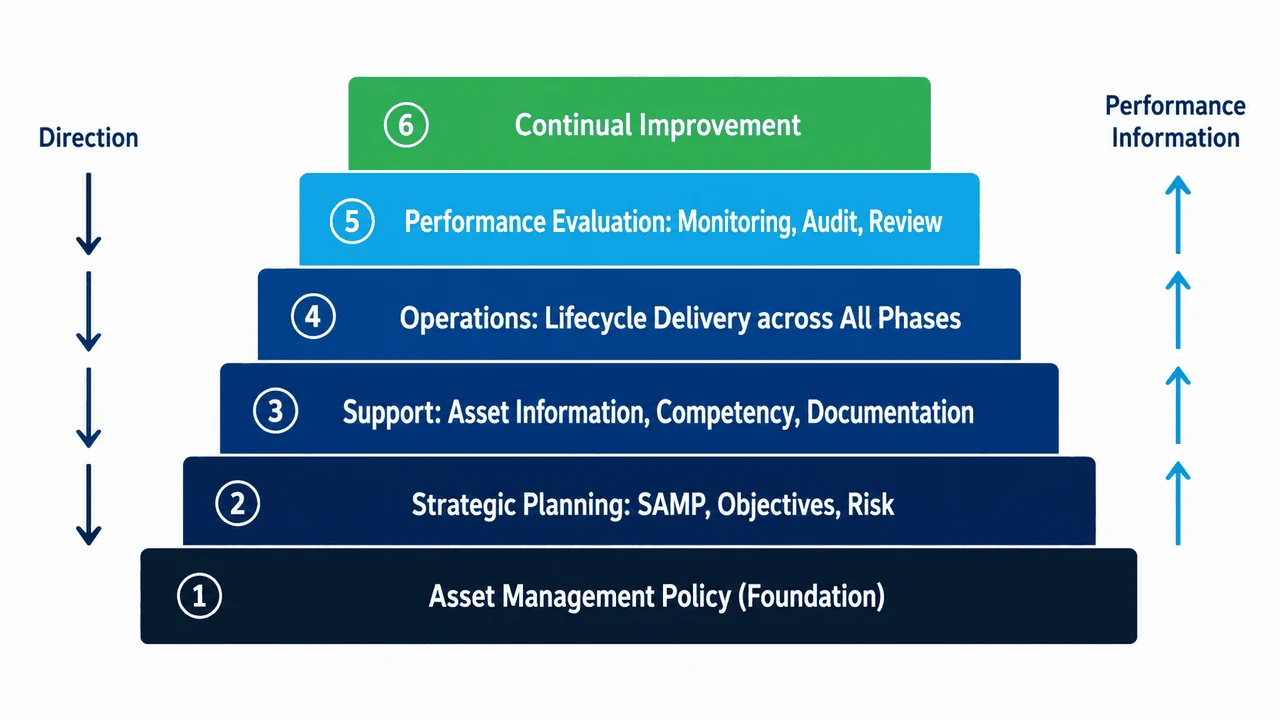
Asset Management Policy: The Foundation
This document establishes the scope of the system, the commitment of the organisation and the accountability structure within which everything else operates. Without a clear policy, endorsed at the appropriate level of leadership, the system has no direction and no authority.
Strategic Planning: SAMP, Objectives and Risk Framework
The SAMP translates policy intent into measurable strategic direction and connects the asset management programme to the overall business plan. Asset management objectives are specific, measurable and owned at the appropriate organisational level. The risk framework identifies and manages risks to achieving those objectives. The SAMP is a strategic document and its audience includes the executive level of the organisation as well as the asset management function.
Support: Asset Information, Competency and Documented Processes
Asset information encompasses the asset register, condition data, maintenance history, performance records, operating parameters and lifecycle cost data. Without reliable asset information, the system makes decisions on assumption rather than evidence. This layer also encompasses organisational competency: the people, skills and knowledge the system depends on, and the processes through which that knowledge is retained and applied.
Operations: Lifecycle Delivery Across All Phases
Delivery occurs across all lifecycle stages: capital project delivery, commissioning, operational control, maintenance execution, renewal assessment and managed decommissioning. This layer is where most technical practitioners spend most of their working time. The asset management system establishes the objectives, standards, constraints and accountability framework within which those activities are planned and executed.
Performance Evaluation: Monitoring, Audit and Management Review
Monitoring and measurement confirms whether the system is producing the outcomes it was designed to produce. Internal audit provides independent assurance that the system is operating as intended. Management review closes the loop: leadership assesses system performance, confirms objectives remain appropriate and makes strategic adjustments where results diverge from intent.
Does This Apply to My Organisation?
An asset management system applies to any organisation that owns and operates physical assets that are material to achieving its objectives. The discipline is not sector specific and the governance principles do not change based on what the assets are or what industry the organisation operates in.
The fundamental challenge is the same across sectors. An organisation managing electricity transmission infrastructure, water treatment facilities, port equipment, hospital buildings, rail corridor assets or process plant faces the same core governance requirement: making sound, coordinated, evidence based decisions about assets at every lifecycle stage, at an acceptable total cost of ownership and with a managed risk profile. The technical specifics differ. The management system requirements do not.
The scale and depth of the system should reflect the scale and complexity of the portfolio. The governance elements remain constant. Their depth, formality and documentation requirements scale with context.
For most organisations the starting point is a structured gap assessment: what elements of a management system already exist in some functioning form, what is entirely absent and what exists in documentation without functioning in practice. That assessment defines the implementation programme. That programme should be prioritised and phased based on risk, lifecycle stage and organisational readiness rather than attempted all at once.
For worked examples of that kind of programme, see the asset management system implementation and global standardisation for managing assets case studies.
What This Means for Your Organisation
An asset management system gives an organisation the ability to make asset decisions on an evidence basis at every level and across every lifecycle stage. It connects the strategic direction set by leadership to the decisions made by every engineer, manager and specialist who interacts with those assets. It provides the governance structure, the information foundation and the process discipline to answer the questions that matter most: what to invest in, what to operate and how, what maintenance strategy to apply, what to renew, what to retire and on what basis each of those decisions is made.
The question is not whether a functioning asset management system would improve outcomes. The question is what its absence is already costing.
Frequently asked questions
Is an asset management system the same as an asset management software platform?
No. An asset management system is a governance architecture: a set of documented policies, objectives, processes and accountabilities that together produce consistent, governed and auditable outcomes. It is not software, not a department and not a maintenance programme.
What is the difference between ISO 55000 and ISO 55001?
ISO 55000:2024 is the international standard that defines the vocabulary and foundational concepts for the asset management discipline. ISO 55001:2024 is the certifiable requirements standard for an asset management system: it specifies what an organisation must establish, implement, maintain and continually improve, structured across ten clauses.
We already have a strong maintenance programme. Is that an asset management system?
No. Delivery is one of the seven groups in the GFMAM Asset Management Landscape. An organisation with a strong maintenance programme operates within that single group, while an asset management system must address all seven, covering context and stakeholders, governance, planning, people, data and information, and the realisation of value with equal governance discipline.
Does an asset management system apply to our organisation?
It applies to any organisation that owns and operates physical assets that are material to achieving its objectives. The discipline is not sector specific and the governance principles do not change based on what the assets are. The technical specifics differ between sectors; the management system requirements do not.
Where should an organisation start?
For most organisations the starting point is a structured gap assessment: what elements of a management system already exist in some functioning form, what is entirely absent and what exists in documentation without functioning in practice. That assessment defines the implementation programme, prioritised and phased based on risk, lifecycle stage and organisational readiness rather than attempted all at once.