
Shivaan Asset Management

Mining

Global Standardisation For Managing Assets

Shivaan Asset Management helped a mining client standardise asset management for global efficiency.

Global standardisation for managing assets
Failure-code adoption within 8 months, from no prior use of codes
78%
Asset classes standardised across the global asset base
100+
Asset class type variations covered by the delivered framework and governance
150+

In brief

  • Every operation classified its assets its own way and failure history sat largely in free text, so the data could not be compared across the business.
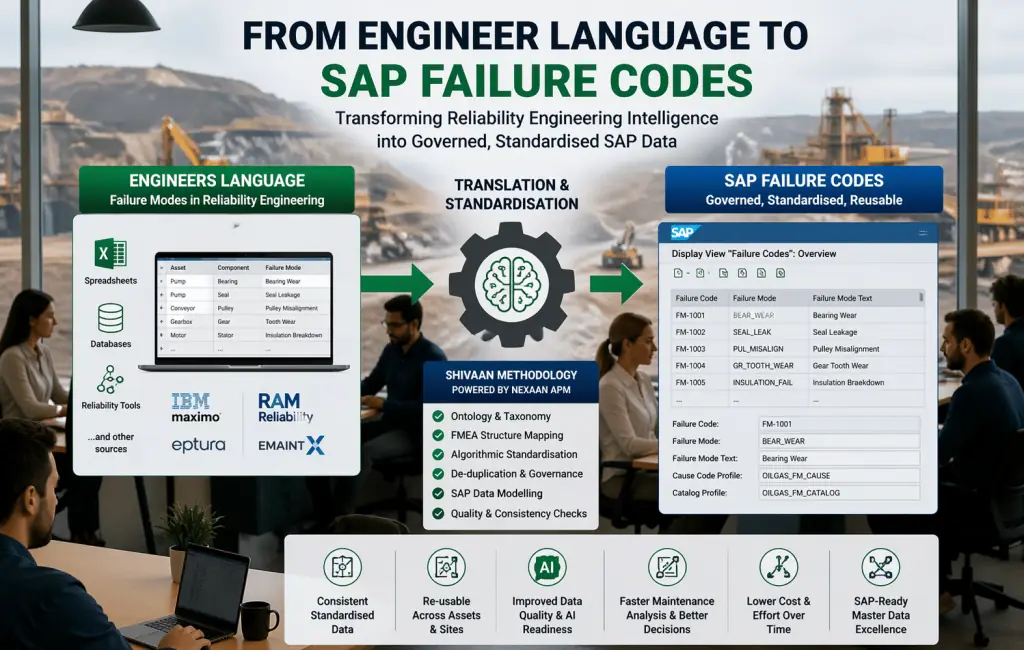
  • Shivaan Asset Management delivered one documented asset classification standard, equipment hierarchies mapped to reference functional locations, a library failure modes and effects analysis (FMEA) dataset, and variation-specific SAP catalog profiles.
  • Failure-code use rose from no prior use to 78% within 8 months of training and the codes going live.
  • Everything delivered sits in the client systems: the library in Snowflake, the codes and governance in SAP, and the training capability in house.

Challenge

Every operation classified its assets its own way. Hierarchies differed from site to site, and failure history lived largely in free text, written one way at one operation and another way somewhere else.

Across a business spanning commodities and countries, data like that cannot be compared at a global level, let alone trusted to carry the analytics and artificial intelligence (AI) ambitions the business holds for its assets. The brief was direct: standardise asset information and data across the Global Mining Company's global operations, and make them AI-ready.

Approach

Shivaan Asset Management built the foundation in deliberate sequence: classify the assets, structure their hierarchies, codify their failure behaviour, then govern how the data is used. Each layer made the next one possible.

  • A documented asset classification standard with clearly defined classification levels for correct use within SAP, covering Mobile, Fixed Plant, Port, Rail and Non-Process Infrastructure assets
  • Equipment hierarchies developed for each asset class type variation, mapped to reference functional locations that standardise functional location levels
  • Ontologies for maintainable items and components, built to support failure modes and effects analysis (FMEA) at library level
  • An extensive library dataset covering every asset class type variation, built with the stakeholders who use it and stored in the client's Snowflake database, accessible from brownfield and greenfield project engineers to reliability engineers
  • Variation-specific SAP catalog profiles, the failure code sets crews select from, developed from the library, loaded into SAP and made available globally to all operations and plants
  • Supervisors and technicians trained on catalog profile use, delivered with the client's internal training team
  • A notification-to-work-order-closure process developed and implemented, with SAP design changes for governance, so a work order cannot be closed without the correct failure codes
  • Live dashboards for maintenance managers covering failures, risks, costs (reactive and preventive) and bad actors, designed around exactly what mattered to them, with additional views for engineers and production

Read how asset class, asset type and variation fit together

This is our five-step method from data chaos to AI readiness, in full.

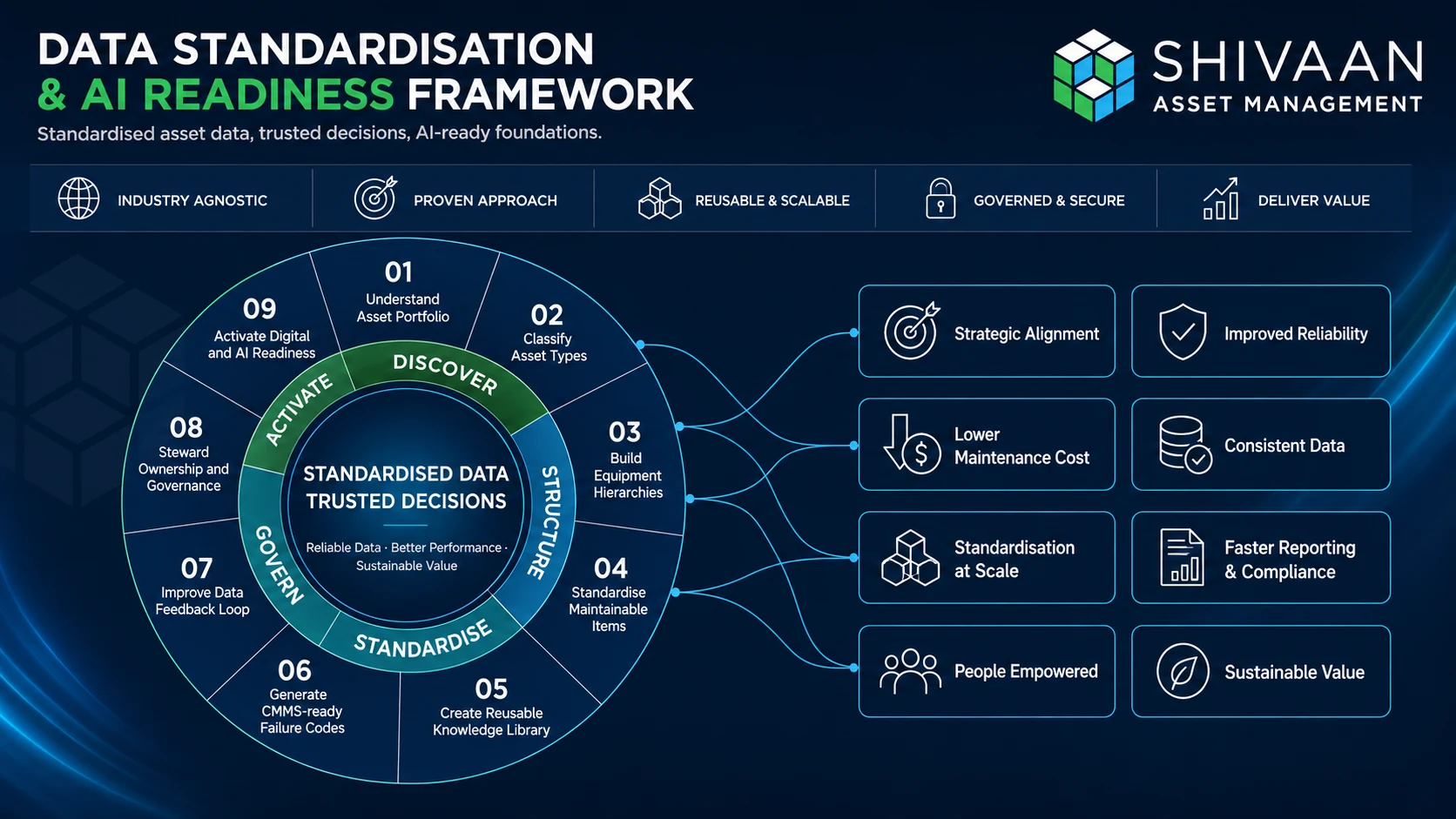
Diagram of the Data Standardisation and AI Readiness Framework: a radial wheel of nine numbered steps grouped into five phases, a band of five guiding principles above and a panel of eight business outcomes alongside, on a dark navy background.
The Data Standardisation and AI Readiness Framework: the five phases and nine numbered steps behind the approach described above.

See the full Data Standardisation and AI Readiness Framework

Outcomes

Once training was delivered and the codes were available, failure-code use rose from no use to 78% over an 8-month period, as crews coded failures with the standardised failure codes and left less of the history in free text. Engineers and management saw immediate value from the live visuals, because failures, risks and costs finally read the same way across operations.

Failure code adoption

Two measured values only, with no intermediate points measured. Before the standardised codes: 0%. After 8 months of use: 78%.

The two measured points stated above: no prior use of failure codes, then 78% adoption 8 months after training was delivered and the codes were available. No months in between were measured.

Behind the adoption number sits the full framework Shivaan Asset Management delivered: process, documentation and governance for every asset class, class type and variation in scope.

Everything delivered lives in the client's own systems: the library in Snowflake, the codes and governance in SAP, and the training capability in house. It is the foundation the business's analytics and AI ambitions now stand on.

  • One documented global classification standard, implemented within SAP
  • A reusable library FMEA dataset in Snowflake, open to every stakeholder who needs it, so new projects start from the same standard
  • Variation-specific failure codes live in SAP across all operations and plants globally
  • Work order closure governed so the correct failure codes are enforced at the source
  • Maintenance managers watching live dashboards built around their own priorities, with views for engineers and production

Frequently asked questions

Why did the asset data need standardising?

Hierarchies differed from site to site and failure history lived largely in free text, written one way at one operation and another way somewhere else. Data like that cannot be compared at a global level, let alone carry analytics and artificial intelligence work.

What was delivered?

A documented asset classification standard for use within SAP, equipment hierarchies mapped to reference functional locations, ontologies for maintainable items and components, a library failure modes and effects analysis (FMEA) dataset held in Snowflake, variation-specific SAP catalog profiles, training for supervisors and technicians, a governed notification to work order closure process, and live dashboards for failures, risks and costs.

How quickly were the standardised failure codes adopted?

Failure-code use rose from no prior use to 78% over an 8-month period, once training was delivered and the codes were available.

What keeps the data correct once the project ends?

A work order cannot be closed without the correct failure codes, which is enforced by design in SAP, and maintenance managers watch live dashboards for failures, risks, costs and bad actors.

Ready to get the same outcome?

Show us the asset system you are trying to improve, and we will map how this approach would apply to it.