

Shivaan Asset Management

Oil & Gas

SAP Failure Codes for Tier 1 Oil and Gas Client

Shivaan Asset Management delivered SAP compliant failure codes (catalog profiles) for a Tier 1 oil and gas client, across 5 asset classes and 44 asset class types in 8 weeks.

SAP failure codes for a Tier 1 oil and gas client
Asset classes
5
Asset class types
44
Time to delivery
8 weeks
Standardised output
100%

In brief

  • A governed SAP failure code library for 5 critical asset classes and 44 asset class types, delivered in 8 weeks as a pilot.
  • The existing failure codes were broad, generic and not asset specific, which blocked reliability analysis, cross site benchmarking and the AI readiness roadmap at the foundation.
  • Delivery followed the five step data chaos to AI readiness methodology, from asset classification through to translating validated failure modes into SAP PM catalog profile codes.
  • Outputs were issued in batches, reviewed and approved by the client, validated in a sandbox, then loaded into SAP production.
  • The pilot became the template: the same structure now scales to the wider asset base without rebuilding the foundation.

Project Overview

A Tier 1 Global Oil and Gas operator engaged Shivaan Asset Management to develop and deliver asset classifications, standardised equipment hierarchies, library FMEA data, and SAP catalog profile-ready failure code loadsheets across their most critical rotating and flow control assets.

Their existing SAP PM environment had failure codes that had been integrated since the SAP implementation. These were broad, generic and not asset specific. The result was fragmented data and component naming, with no use of damage and cause codes that could support reliability analysis or be meaningfully compared across sites. Cross site benchmarking was impossible. Their predictive maintenance ambitions and AI readiness roadmap were blocked at the foundation, because the data itself could not support them.

The client approached this work as a pilot project. It was a deliberate decision to prove the methodology, measure the outcomes, and build an internal business case for scaling the approach enterprise wide, while also enabling AI models to learn from clean data before their dead data could be annotated for use. Shivaan Asset Management delivered the complete pilot scope in 8 weeks.

Scope Of Work

Shivaan Asset Management was contracted to design and deliver a governed failure code library for five critical asset classes commonly found across oil and gas processing, compression, and flow control operations, covering 44 distinct asset class types in total.

  • Valves (22 types)
  • Pumps (10 types)
  • Compressors (5 types)
  • Engines (2 types)
  • Gas Turbines (2 types)

The scope of our activities included:

  • Asset classification with defined boundary limits for each of the 44 asset class types, establishing what is inside and outside the asset scope.
  • Development of standardised equipment hierarchies, with one consistent parent and child template per asset class type, applied uniformly across every asset instance.
  • Construction of a maintainable item and component ontology derived from the equipment hierarchy, providing the bridge between engineering analysis and SAP PM record structure.
  • Creation of a validated FMEA library covering the dominant failure modes for each asset class type, structured for fleet wide reusability.
  • Translation of FMEA failure modes into SAP PM catalog profile conventions, including maintainable item codes, component codes, damage codes, and cause codes.
  • Preparation of SAP compliant loadsheets for every asset class type, validated through a sandbox environment prior to production load.
  • Structured batch based review cycles with the client's SAP master data team for approval, followed by loadsheet submission for production deployment.

How asset classes, class types and variations are defined

Why Pilot approach first

The client recognised early that SAP failure code development at this depth, combining reliability engineering, asset classification, SAP master data structure, and catalog profile compliance, is specialist work. It requires an end to end capability that is uncommon in the Australian market. This includes reliability engineering expertise that does not stop at the FMEA report, SAP integration knowledge that does not stop at technical compliance, and industry specific asset understanding that does not rely on generic templates.

By running the engagement as a pilot, the client could validate the methodology on a defined, high value scope, measure the outcomes against their traditional approach, and build the internal business case for scaling the work across their broader asset base. The pilot became the template. Everything that follows it can be scaled without rebuilding the foundation.

Approach

Shivaan Asset Management combined reliability engineering experience, deep SAP PM master data knowledge, and oil and gas asset specific understanding with a structured, phased delivery approach that kept the client's operational teams engaged without disrupting their day to day work.

Our team:

  • Analysed the client's existing SAP PM and Catalog Profiles design configuration, and existing FMEA's for assets in scope to leverage their existing language and nomenclatures.
  • Applied Shivaan Asset Management's data chaos to AI readiness framework, a five step methodology spanning Asset Classification, Equipment Functional Hierarchy, CMMS taxonomy standardisation, FMEA library development, and Engineer to SAP language translation.
  • Engaged with reliability engineers and the SAP master data team throughout the project, ensuring the outputs reflected business and operating context.
  • Delivered outputs in structured batches. Each batch was submitted for client review, approved, validated in the client's sandbox environment, then loaded into SAP production.

The five step methodology applied

Our data chaos to AI readiness framework turns fragmented SAP failure code environments into governed, reusable, AI ready data. Each step builds on the last, with clear inputs, actions, and outputs along the way.
  1. Classify and Define Boundaries
    • Every one of the 44 asset class types is classified with defined boundary limits. Ambiguity is eliminated at the start and every downstream deliverable references the same asset scope.
  2. Functional Hierarchy
    • Equipment is systematically organised into logical parent and child structure for maintainable item and component standardised ontology. One hierarchy template per asset class type, applied uniformly.
  3. Standardise CMMS Taxonomy
    • A consistent naming and classification convention is applied across the asset register. It becomes the addressing system for every asset entering the SAP environment, now and in the future.
  4. FMEA Library (80/20 Rule)
    • The dominant failure modes driving the majority of operational impact are documented in a structured FMEA library. Standardised, reusable, and validated for fleet wide application.
  5. Translate Engineer to SAP
    • FMEA failure modes are converted into SAP PM catalog profile data, including maintainable item, component, damage, and cause codes. Delivered as loadsheet ready files for internal sandbox testing and production deployment.
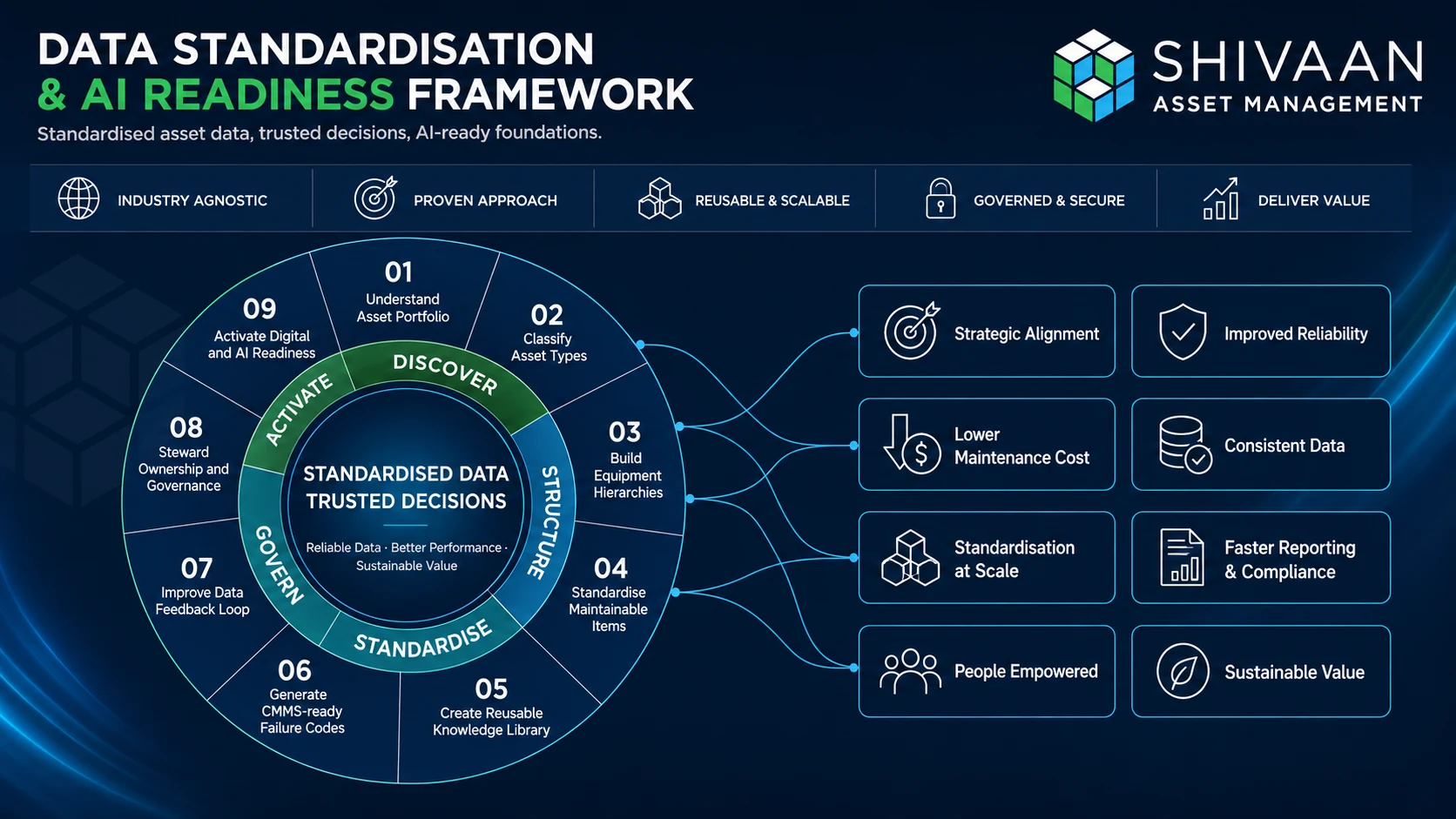
Diagram of the Data Standardisation and AI Readiness Framework: a radial wheel of nine numbered steps grouped into five phases, a band of five guiding principles above and a panel of eight business outcomes alongside, on a dark navy background.
The wider Data Standardisation and AI Readiness Framework: five phases and nine numbered steps. The five step methodology applied on this engagement sits inside it.

Read the framework in full, phase by phase

Nexaan APM

Project Outcomes

Every one of the 44 asset class types was delivered, reviewed and approved within the 8 week timeline with great support from internal stakeholders.

The outcomes delivered across the engagement:

  • 5 asset classes and 44 asset class types with complete classification, boundary limits, and consistent equipment hierarchies.
  • Standardised maintainable item and component ontology replacing fragmented site by site conventions with a single governed structure.
  • Complete FMEA failure mode library for all 44 asset class types, structured for scalable fleet wide reuse.
  • SAP PM catalog profile compliant failure code loadsheets covering maintainable item, component, damage, and cause codes, delivered to the client's SAP master data team for production loading.
  • 100% standardisation across all deliverables, compared with the 5% or higher error and inconsistency rate that, in our experience, is typical of traditional manual approaches.
  • All technical capability and delivery categories scored 5.0 out of 5.0 in the client's independent post project feedback, with a Net Promoter Score of 10 out of 10.
  • Recognised by the client as a trusted partner of choice for reliability engineering to SAP integration work, positioning Shivaan Asset Management for the next phase of scaled rollout across their broader asset base.

Traditional approach vs Shivaan AM (illustrative comparison)

The illustrative comparison below shows the scale of improvement against how this work has, in our experience, historically been delivered in the industry. Same scope, same rigour, radically different delivery outcome.

MetricTraditional approach (illustrative)Shivaan AM
Duration12 to 18 months8 weeks
Team required5 to 8 reliability engineers2 engineers
Cost (AUD)$800K to $1.9MLess than 10% of traditional
Output formatSpreadsheets, manual SAP loadsheet developmentStandardised, SAP compliant, loadsheet ready
StandardisationAt least 5% errors or inconsistenciesNo errors identified in the client's assessment
Knowledge retentionLeaves with the engineerSystem governed, stays with the business
Reusability for future assetsLow, engineer dependentFull, governed and fleet scalable
Governed six-stage SAP data workflow: Classify assets and define boundaries; Build equipment hierarchies; Standardise CMMS taxonomy; Build the FMEA library; Translate validated FMEA data into SAP PM catalog profile codes; Reviewed, approved and sandbox-validated SAP loadsheets for production deployment.
Final stage: Reviewed, approved and sandbox-validated SAP loadsheets for production deployment.
Duration
Up to 9x faster
Illustrative: 8 weeks, compared with 12 to 18 months for a typical traditional approach.
Team required
75% fewer resources
Illustrative: 2 engineers, compared with 5 to 8 reliability engineers for a typical traditional approach.
Cost (AUD)
90%+ cost reduction
Illustrative: less than 10% of the traditional $800K to $1.9M.

Comparison basis: a typical traditional manual failure code development program of equivalent scope. The traditional figures, and the improvements derived from them, are illustrative rather than sourced benchmarks.

At project completion, the client completed an independent feedback assessment covering technical capability, delivery quality, and collaboration. All 11 dimensions were rated 5.0 out of 5.0, with a Net Promoter Score of 10 out of 10 (charted below).

Value Delivered

The 8 week delivery and the cost saving are the headline. The structural change to how the client's asset data works, and keeps working, is the enduring value. Shivaan Asset Management did not deliver a consulting report. We delivered a governed capability that the client now owns, operates, and extends independently.

The primary value delivered to the business:

  • A governed failure code library that survives team changes. Because failure codes were built to a structured ontology rather than assembled from individual engineer knowledge, the library persists in SAP as a managed asset. When experienced reliability engineers move on, their knowledge remains in the system. It stays documented, governed, and accessible to anyone in the business.
  • Reusability that compounds over time. When a new asset of the same class type enters the fleet through acquisition, capital expansion, or new site development, the failure analysis does not need to be redone. The codes already exist, correctly structured, and ready to apply. The investment in this pilot pays forward into every future project of the same asset type.
  • Cross site benchmarking that is actually credible. Every asset of the same class type is now coded consistently using the same damage and cause codes. Failure patterns across sites can be compared meaningfully. The data is no longer an artefact of different coding conventions. It reflects real operational behaviour.
  • A foundation for AI and predictive maintenance. Machine learning models, digital twins, and predictive maintenance programs can only be as accurate as the data feeding them. Structured, consistent failure data is the prerequisite, not an afterthought. This pilot established that foundation for the client's broader digital roadmap.
  • Lower cost of SAP ownership. With a governed catalog profile structure and consistent hierarchy underlying it, SAP PM data can be extended, audited, and managed without degrading the standardisation established here. New assets land in the right place. Existing assets can be reviewed against a known standard. The long term cost of maintaining data integrity falls.
  • ISO 55001 (Asset Management Systems), ISO 14224 (Collection and Exchange of Reliability and Maintenance Data for Equipment) and ISO 55013 (Management of Data Assets) alignment. The governed library aligns naturally with the asset information, reliability data, and data asset management expectations of these standards. Documentation, traceability, and controlled change position the client's Asset Management System for maturity assessment and continual improvement.
  • A validated template for scaling. The pilot deliverables now serve as the template for extending failure code governance across the client's broader asset fleet, with the confidence of a proven methodology, a measured outcome, and an internal business case grounded in real data.

What changed in ISO 55001:2024

By delivering this engagement as a structured pilot, Shivaan Asset Management gave a major Global Oil and Gas operator the foundation they needed for long term data governance. In a fraction of the time, at a fraction of the cost, and with an outcome measurable enough to build the case for fleet wide rollout.

This is not master data cleanup. It is the architectural foundation on which reliability, predictive maintenance, digital twin, and AI initiatives actually work.

Frequently asked questions

What are SAP failure codes, and why did these ones need rebuilding?

Failure codes are the damage and cause codes recorded against Notifications and Work Orders in SAP PM. Here they dated back to the original SAP implementation and were too generic to be useful: the same broad codes applied to unlike components, so the records could not feed reliability analysis or stand up to comparison between sites.

How was the work delivered in 8 weeks?

The scope ran through a five step methodology, with outputs issued in structured batches rather than as one final report. Each batch was reviewed and approved by the client, validated in their sandbox environment, then loaded into SAP production, so review and loading ran alongside development instead of after it.

Why run the engagement as a pilot?

A pilot let the client validate the methodology on a defined, high value scope, measure the outcomes against their traditional approach, and build the internal business case for scaling the work across their broader asset base. The pilot deliverables then became the template, so everything that follows can be scaled without rebuilding the foundation.

What does the client keep when the engagement ends?

A governed failure code library that lives in SAP as a managed asset rather than in the knowledge of individual engineers, standardised equipment hierarchies and a maintainable item and component ontology, a validated FMEA library structured for fleet wide reuse, and the loadsheets and conventions needed to code new assets of the same class type without redoing the analysis.

Independent client assessment: all 11 dimensions rated 5.0 out of 5.0. Dimensions: Reliability engineering (RCM, FMEA); Asset hierarchy quality; Failure code development; SAP master data and catalog profiles; RE to SAP integration; Industry asset understanding; Communication and availability; Deliverable quality and accuracy; Timeline management; Value for investment; Professionalism.

Independent client feedback

5.0 out of 5.0, across all 11 assessment dimensions

At project completion the client completed an independent feedback assessment covering technical capability, delivery quality and collaboration. Every dimension was rated at the maximum.

Net Promoter Score
10 / 10
All 11 dimensions
5.0 / 5.0
Categories at maximum
100%

Ready to get the same outcome?

Show us the asset system you are trying to improve, and we will map how this approach would apply to it.