
In brief
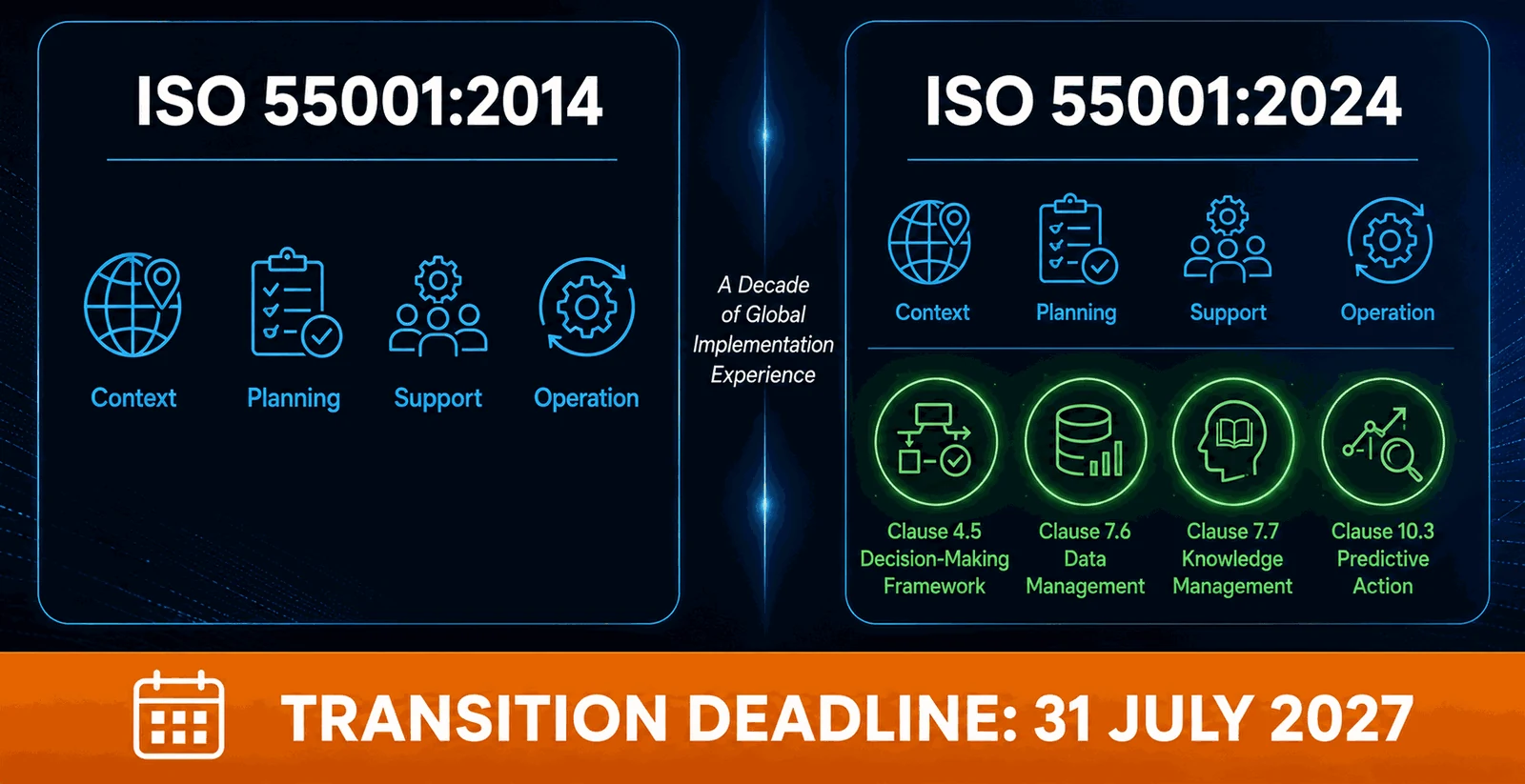
- ISO 55001:2024 makes seven substantive changes to the 2014 edition, including a new decision-making framework clause, a substantially revised data and information clause, and a new knowledge management clause.
- For organisations currently certified to ISO 55001:2014, the transition deadline is 31 July 2027.
- The standard still does not address implementation methodology, reliability engineering or asset criticality methodology, and it treats the cultural dimensions superficially.
- Certification confirms the minimum requirements are met. It does not confirm that asset management is embedded in how the organisation actually operates.
Most organisations encounter ISO 55001 through a compliance lens. A certification requirement lands, a gap analysis is commissioned, a system is documented, and an audit is passed. That sequence is not wrong. But it consistently misses the deeper question: does it produce an organisation that actually manages assets well? The answer depends almost entirely on whether the process is treated as a documentation exercise or as a genuine capability-building program.
Jitesh Patel, Director of Shivaan Asset Management, was an active member of ISO/TC 251 through the 2024 review cycle, reviewing draft versions, evaluating stakeholder feedback submissions and presenting outcomes to project leads. He also contributed to the third edition of the GFMAM Asset Management Landscape, published in June 2024. Both the standard and the Landscape were updated in the same cycle, and this article draws on that combined participation to offer a practitioner's view: what changed, what the 2024 revision gets right, where the genuine gaps remain, and how to use this body of knowledge to build something more durable than a certificate.
Three Documents, One Discipline
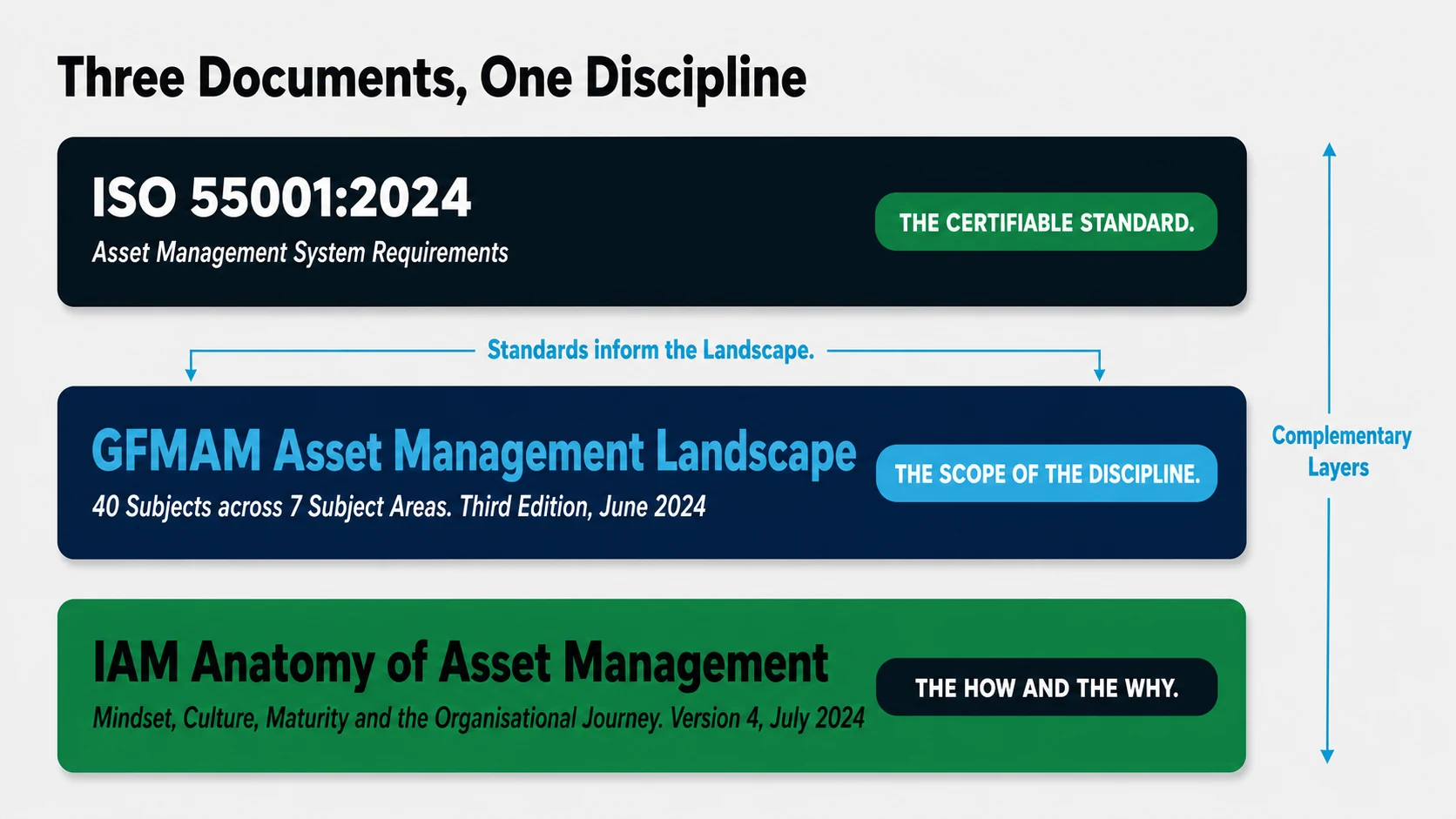
Before assessing what changed, it helps to understand the architecture of knowledge you are working with. Three documents define the current state of the asset management discipline, and all three were updated in 2024. They are not competing frameworks. They address complementary layers of the same body of practice.
- ISO 55001:2024 is the only certifiable standard in the ISO 55000 series. It specifies the minimum requirements for an Asset Management System. Think of it as the governance floor: what must demonstrably be in place for an independently verified management system to exist. ISO 55000 provides the vocabulary and principles. ISO 55002 provides application guidance. ISO 55010, also updated in 2024, addresses the financial dimensions.
- GFMAM Asset Management Landscape, 3rd Edition (June 2024) maps the full scope of the discipline across 40 subjects and seven subject areas: Context and Stakeholders, Governance, Asset Management Planning, Leadership and People, Data and Information, Delivery, and Value Realization. Where ISO 55001 defines the minimum requirements, the Landscape defines the full territory. It has addressed decision-making, data governance and knowledge management as dedicated subjects since its first edition.
- IAM Anatomy of Asset Management, Version 4 (July 2024) addresses the organisational journey: how culture, leadership behaviour and institutional knowledge determine whether a management system delivers what it was designed to produce. The Anatomy is explicit that a management system cannot specify or monitor everything. The human and cultural dimensions are what determine whether the system functions as intended.
These three documents ask different questions of an organisation. ISO 55001 asks whether your system meets the requirements. The GFMAM Landscape asks whether you are addressing the full scope of the discipline. The IAM Anatomy asks whether your organisation is genuinely capable of doing this well. Answering yes to the first question while being unable to honestly answer the second and third means you have a certification, not an asset management capability. That distinction matters for every decision this article addresses.
What Changed Between 2014 and 2024
Ten years of global implementation produced a consistent picture of where the 2014 standard was falling short. Decision frameworks were informal or undocumented. Data was poor in quality and disconnected from decision-making. Knowledge was concentrated in individuals rather than systems. Risk and opportunity analysis was conflated into a single activity. The 2024 revision addresses these gaps with seven substantive changes.
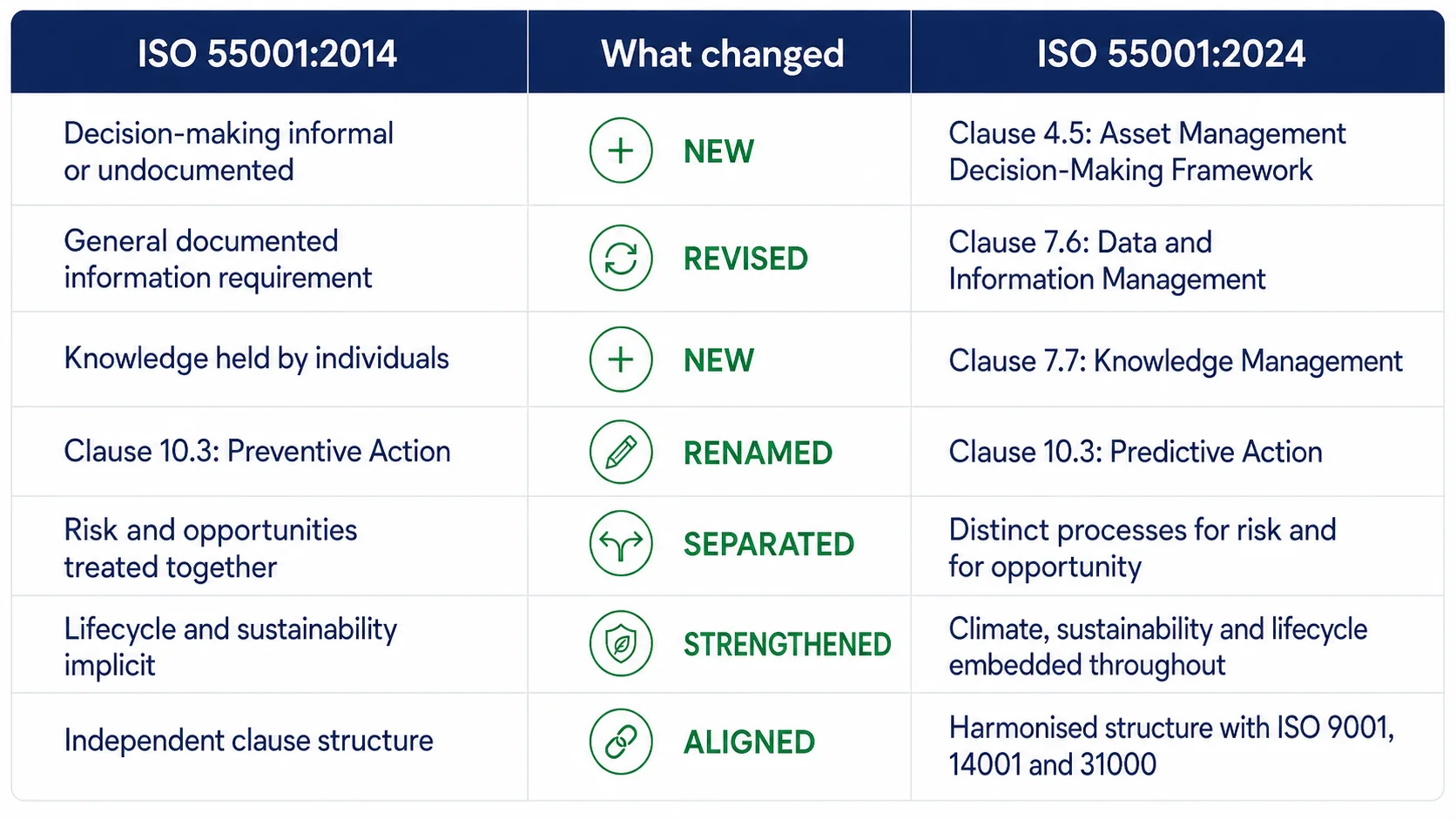
- Clause 4.5 (new): Asset management decision-making. Organisations must now document the framework governing how asset management decisions are made, including the criteria, processes and delegation structures. This formalises what the GFMAM Landscape has treated as a dedicated subject (Decision-Making, subject 3.5) since its first edition.
- Clause 7.6 (substantially revised): Data and information. Elevated from a general documented information requirement to a dedicated subclause. Data attributes, quality standards and sources must be documented. Financial and non-financial data traceability is now explicitly required. This directly targets one of the most persistent failures in applied asset management: decisions made on asset information and data that is inconsistently recorded, incomplete or structurally incapable of reliable analysis.
- Clause 7.7 (new): Knowledge. Organisations must demonstrate how they identify, retain and update the knowledge needed for asset management, including processes for addressing succession risk as experienced personnel leave. The GFMAM Landscape has addressed knowledge management as a distinct subject (4.6) since its first edition. The standard has now made it a formal requirement.
- Clause 10.3 (renamed): Predictive action. Previously Preventive action, this clause is reframed around optimising the timing of asset interventions across maintenance, renewal, replacement and disposal. The orientation shifts from preventing management system nonconformities to anticipating and optimising asset-level outcomes.
- Risk and Opportunity Separated. The 2014 edition treated risk and opportunities together. The 2024 edition requires distinct processes for each. Opportunity capture is now a managed discipline in its own right, not an occasional by-product of risk assessment.
- Lifecycle and Sustainability Strengthened. Climate change, long-term sustainability and lifecycle thinking are explicitly embedded throughout, reflecting the direction already taken by the GFMAM Landscape third edition with Sustainable Development as a dedicated subject and climate resilience addressed across multiple others.
- Harmonised Structure Adopted. ISO 55001:2024 aligns with the common clause framework used across ISO 9001, ISO 14001 and ISO 31000. For organisations operating integrated management systems, this reduces duplication. It also formally positions asset management as a peer discipline alongside quality and environmental management at the governance level.
It is worth noting what has not changed. The Plan-Do-Check-Act structure that underpins all ISO management systems is preserved. The Strategic Asset Management Plan, Asset Management Plans, objectives and the requirement for demonstrable value delivery remain central. The auditable evidence trail remains the basis for certification. The 2024 revision strengthens and extends the requirements. It does not rebuild them from scratch.
What the 2024 Standard Gets Right
The 2024 revision makes genuine progress in areas that practitioners have been working around for years. Acknowledging this matters: understanding what has genuinely improved helps organisations focus their transition effort on the requirements that will produce the most value.
The decision-making framework requirement in Clause 4.5 is long overdue and substantively important. The absence of an explicit requirement in the 2014 edition allowed organisations to certify while continuing to make major capital decisions on precedent, budget availability and individual preference rather than documented criteria. Clause 4.5 creates the governance structure for an organisation to demonstrate, not just claim, that its asset investment logic is structured and consistent. For boards and audit committees, this clause creates an assurance requirement they can now formally review.
The data and information requirements in Clause 7.6, while leaving much implementation detail to the organisation, send a clear signal that data quality is a governance obligation. The financial and non-financial traceability requirement is particularly consequential: asset decisions with financial implications must now be traceable to the data and analysis that informed them. This directly supports ISO 55010 on the financial dimensions of asset management, and it connects to the kind of documented assurance that investors and regulators in asset-intensive industries are increasingly requiring.
The knowledge management requirement in Clause 7.7 arrives at the right time for most asset-intensive industries. Retirements, restructuring and skills shortages are removing institutional knowledge faster than most organisations are replacing it. The clause gives the asset management function a formal mandate for work that most operations managers already know is critical but few have had the governance backing to prioritise. The maintenance supervisor who holds fifteen years of failure history and contextual knowledge on a critical piece of rotating equipment is a knowledge asset. When that person leaves, the knowledge leaves unless the organisation has built systems to prevent it.
What the Standard Does Not Address
No standard is complete, and acknowledging the genuine gaps in ISO 55001:2024 is not a criticism. It is an honest appraisal of what the document cannot provide and where additional work is needed. Organisations that understand these gaps approach their transition with better-calibrated expectations and more effective programs.
- Implementation methodology is absent. ISO 55001 specifies requirements but does not provide an organisation specific implementation method. Establishing data governance, structured failure coding, controlled asset information and a reliable asset register can require substantial technical and organisational work. The sequence and duration depend on the starting point, scope, system landscape and evidence quality. Transition plans should not mistake document updates for functioning capability.
- Reliability engineering is not referenced. FMEA, RCM, Weibull analysis, RAM modelling. None appear in ISO 55001. A certifiable asset management system that does not require any structured reliability methodology represents a structural weakness, particularly for industries where equipment failure modes and their consequences are the primary driver of operating cost and risk. The GFMAM Landscape addresses reliability-centred approaches within its Delivery subject area. The certifiable standard does not.
- Asset criticality methodology is not required. Criticality assessment is foundational to prioritisation across maintenance scheduling, capital allocation and inspection frequency. Without a documented criticality methodology, organisations can satisfy the decision-making framework requirement with processes that appear structured but are not grounded in a systematic understanding of which assets and failure modes carry the greatest consequence.
- Cultural and behavioural dimensions are treated superficially. The IAM Anatomy dedicates significant attention to the organisational conditions that determine whether asset management functions as intended: leadership behaviours, decision culture and front-line alignment. ISO 55001 addresses competence and awareness requirements but stops well short of the organisational capability dimensions that the Anatomy identifies as determinative. A management system can be fully conformant while the daily decision-making culture of the organisation quietly undermines it.
- Industry-specific applicability is absent by design. The standard is deliberately generic. This creates a significant translation burden for organisations in mining, rail, utilities, aviation and other sectors where asset classes, failure economics and regulatory environments differ substantially from the generic management system model. Organisations that apply the standard without translating its requirements through their specific industry context tend to produce systems that are conformant but operationally disconnected.
These gaps are not reasons to discount the standard. They are the context in which a well-designed implementation program must operate. An ISO 55001:2024 transition that also closes the reliability methodology gap, establishes a criticality framework and genuinely addresses data quality will produce an organisation that outperforms one that simply achieves the certificate.
Making It Operationally Relevant
The most common failure mode in ISO 55001 implementation is not non-conformance. It is conformance without operational connection. Management systems are built that satisfy requirements in form while daily decisions continue to be made by the same informal processes, with the same data quality limitations, that existed before the system was built. The system and the operation exist in parallel rather than as the same thing.
The corrective is to implement the standard from business needs inward, not from the standard outward. The question is not what does Clause 4.5 require. The question is what decisions matter most to our business, and do we have a framework that ensures those decisions are made consistently and on the basis of reliable evidence. When the answer to the second question is genuinely yes, the first resolves itself. Below are the four key practice areas where this principle determines whether an ISO 55001 system delivers real value.
- Decision-making quality: Can you trace a major capital commitment back to the documented criteria that governed it? Can you demonstrate that a maintenance deferral was assessed against a risk framework rather than a budget constraint alone? Can you show that your asset replacement timing reflects a lifecycle analysis rather than an age assumption? These are the practical tests of whether the decision-making framework requirement is met in substance.
- Data integrity: Are the systems where your asset information and data are maintained structured well enough to answer operational questions reliably? Can you extract meaningful failure history by asset class, failure mode and operating context? Is your asset register complete, current and linked to both operational and financial data? Most organisations know the honest answer to these questions. The 2024 standard makes closing the gap a governance obligation, not an aspiration.
- Knowledge retention: Where is the critical operational knowledge in your organisation? Who holds it, how is it currently structured, and what happens to it when those individuals leave? Treat this as a risk management question first. Identify the critical knowledge holders, map what they know, quantify the succession risk, and build structured capture programs before the knowledge walks out the door.
- Line of sight: Can the people who maintain your assets connect their daily decisions to organisational objectives? Do they understand how their work contributes to asset performance and business outcomes? The IAM Anatomy describes this as line of sight, and it is the cultural condition that determines whether good management systems produce good operating outcomes. No clause requirement achieves this. Leadership behaviours and organisational design do.
These four practice areas cut across every section of ISO 55001:2024. Organisations that use the transition process to build genuine depth in each of them will emerge with an asset management capability that delivers value well beyond the certification cycle.
For a worked example of the data integrity work behind the second of those four, see the failure coding case study. For the management system itself, see the asset management system implementation case study.
Certification or Capability: A Question Worth Asking
ISO 55001 certification is a credible external signal that an internationally recognised set of requirements has been independently verified. For regulated industries, government asset owners and organisations tendering for major infrastructure work, it carries genuine procurement value. These are legitimate reasons to pursue certification, and this article does not argue against it. The argument is against mistaking the certificate for the outcome.
The GFMAM Landscape is direct: asset management maturity is not limited to the stages achieved in meeting ISO 55001 requirements. It looks beyond compliance to the characteristics that organisations exhibit at higher levels of maturity. The IAM Anatomy reinforces this from an organisational perspective: in a large organisation, it will often take five or ten years for asset management to become embedded as a business-as-usual activity. The goal is for asset management to be part of how the organisation naturally operates (embedded in its planning, decisions and culture), not a compliance program that runs alongside daily work.
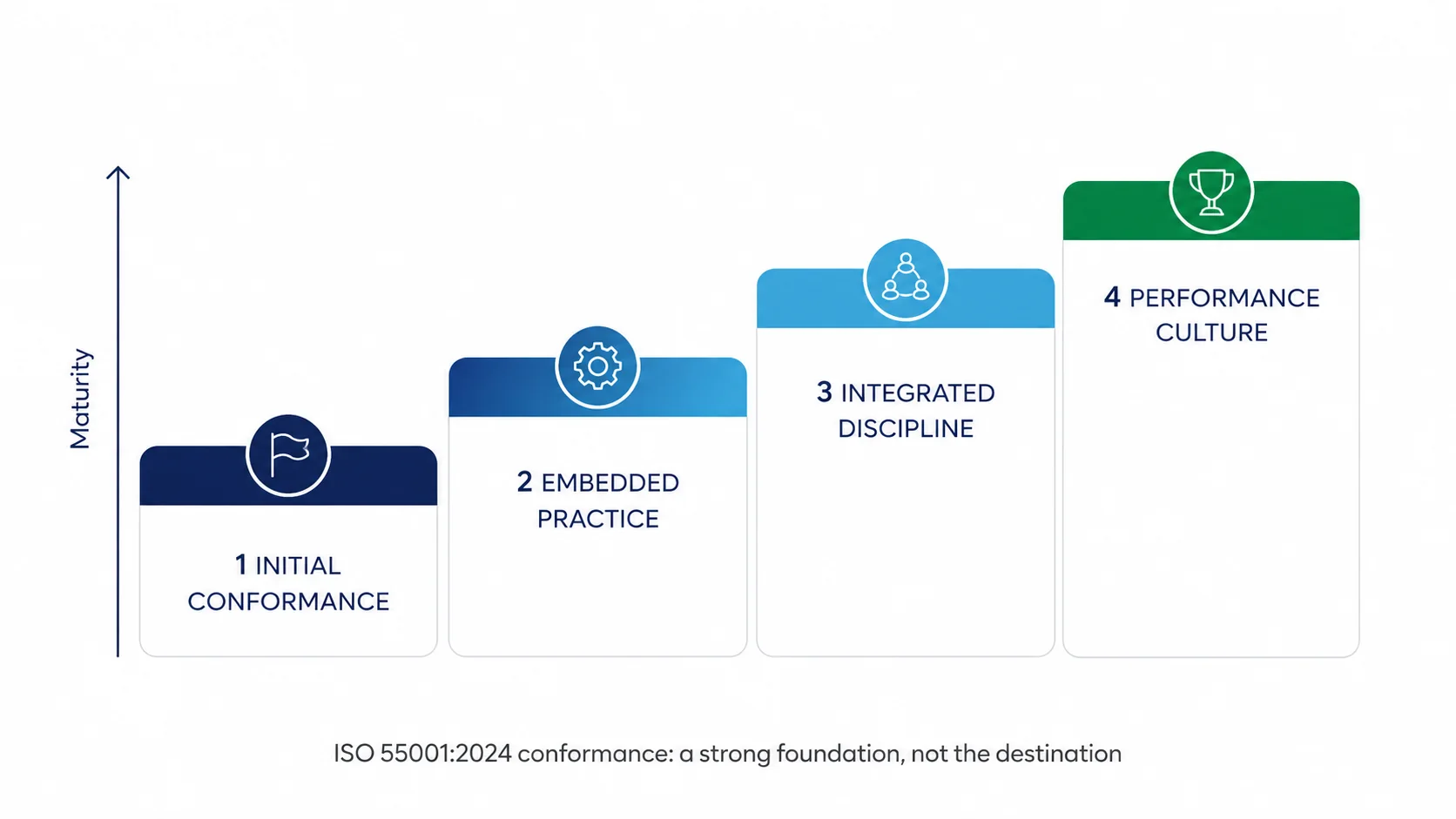
What does the journey from certification to genuine maturity look like in practical terms? Four levels describe the progression. This four-level scale is specific to the ISO 55001 certification-to-maturity journey; it is not the five-level asset management maturity scale in our asset management maturity guide, where ISO 55001 conformance corresponds to that scale's Level 3 rather than to Level 1 here.
Level 1: Initial Conformance
The management system is documented, the 2024 requirements are met and conformance is independently verified. The certificate is held. This is the governance foundation. For organisations where asset management thinking has not previously been formalised, it is a significant and valuable step. But it is the starting point of the journey, not its destination.
Level 2: Embedded Practice
Data quality has improved to a level where it genuinely supports the decisions being made from it. The decision-making framework is applied consistently, not just documented for audit. Knowledge capture programs are underway. The management system is beginning to change how the organisation actually operates rather than describing how it theoretically should.
Level 3: Integrated Discipline
Technical, financial and operational data is connected across functions. Decision-making frameworks are applied at all levels, not just at the asset management team. Knowledge management is institutional rather than individual. Cross-functional alignment is visible in how maintenance planning, capital investment and operational decisions relate to each other and to organisational objectives.
Level 4: Performance Culture
Asset management is how the organisation works. The management system provides the governance structure, but it does not need to direct every decision because the thinking is embedded in culture and daily practice. The IAM Anatomy describes this as everyone who touches or influences an asset understanding how their work connects to the organisation's objectives. At Level 4, that understanding is self-sustaining.
Shivaan Asset Management works with organisations at all four levels. The certification matters at Level 1. The business value, in reduced failure costs, better capital decisions, stronger knowledge retention and genuine operational alignment, is built in the progression from Level 1 to Level 4. The transition to ISO 55001:2024 is the opportunity to accelerate that progression, not just renew the certificate.
Planning Your Transition
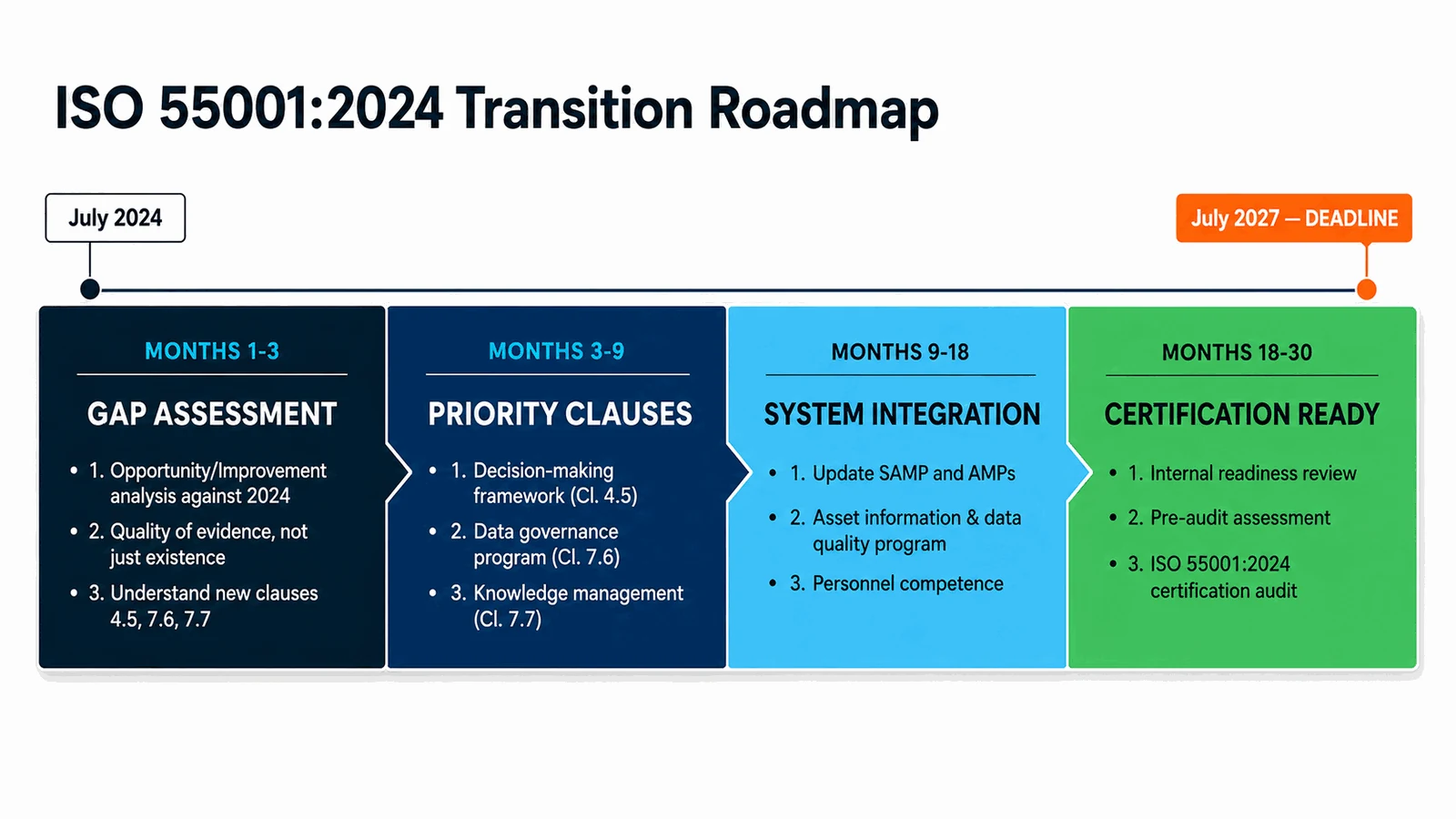
For organisations currently certified to ISO 55001:2014, the transition deadline is 31 July 2027. Work backwards from that fixed date using the organisation's current evidence quality, audit arrangements, system complexity and available capability. An effective transition addresses standard requirements and the underlying operating capability together. Treating them separately risks producing a system that satisfies an audit but does not improve decisions.
- Gap assessment. Evaluate evidence quality, not just evidence existence. Confirm the applicable transition requirements with the certification body and identify where the 2024 edition requires changes to working practices, information, governance or documented evidence.
- Priority capabilities. Assign accountable owners and build the capabilities with the greatest gap or consequence. These may include decision governance, data and information management, knowledge management, lifecycle planning and externally provided activities.
- System integration. Update the SAMP, asset management objectives, plans, processes, information controls, competence arrangements and internal assurance so the changes operate as one management system rather than separate projects.
- Readiness and certification. Test the complete system, close evidence gaps, complete internal review and coordinate the certification audit before 31 July 2027. The sequence and timing should be compressed or expanded only after the organisation has assessed what can be completed credibly.
The transition period is also the best opportunity to address what the standard does not cover. Adding an Asset information & data quality program, establishing a documented criticality methodology and embedding a structured reliability engineering approach alongside the ISO 55001 transition produces an organisation that emerges not just with a renewed certificate, but with demonstrably stronger asset management capability than it had going in.
The Standard Is a Floor, Not a Ceiling
ISO 55001:2024 is a stronger document than its predecessor. The requirements for decision-making frameworks, data quality and knowledge management reflect a more serious understanding of what effective asset management infrastructure looks like. Organisations that engage with these requirements substantively will produce something durable: a governance system that is genuinely capable of supporting better decisions, protecting institutional knowledge and demonstrating value to the business.
But the standard describes a floor, not a ceiling. Conformance with ISO 55001:2024 confirms that an organisation meets the minimum requirements of an internationally recognised asset management system. It does not confirm that asset management is embedded in the organisation's culture, that decisions are consistently evidence-based, that data integrity is sufficient for the demands placed on it, or that the full value of the asset portfolio is being realised. Those outcomes require a maturity journey that extends well beyond the audit cycle. The GFMAM Landscape and the IAM Anatomy both describe a discipline broader and deeper than any certifiable standard can fully capture. ISO 55001:2024 points clearly in the right direction. The work required to get there is the work worth doing.
Frequently asked questions
When is the ISO 55001:2024 transition deadline?
For organisations currently certified to ISO 55001:2014, the transition deadline is 31 July 2027. The ISO 55001:2024 certification audit needs to be completed before that date.
What changed between ISO 55001:2014 and ISO 55001:2024?
Seven substantive changes: a new Clause 4.5 asset management decision-making framework, a substantially revised Clause 7.6 on data and information management, a new Clause 7.7 on knowledge management, Clause 10.3 renamed from Preventive Action to Predictive Action, risk and opportunity separated into distinct processes, lifecycle and sustainability strengthened throughout, and a harmonised clause structure aligned with ISO 9001, ISO 14001 and ISO 31000.
What does ISO 55001:2024 not address?
Implementation methodology is absent, reliability engineering is not referenced, asset criticality methodology is not required, cultural and behavioural dimensions are treated superficially, and industry-specific applicability is absent by design. These are not reasons to discount the standard; they are the context a well-designed implementation programme has to operate in.
Is certification the same as asset management capability?
No. Conformance with ISO 55001:2024 confirms that an organisation meets the minimum requirements of an internationally recognised asset management system. It does not confirm that asset management is embedded in the culture, that decisions are consistently evidence-based, that data integrity is sufficient for the demands placed on it, or that the full value of the asset portfolio is being realised.
Where should a transition programme start?
With a clause-by-clause gap assessment of evidence quality, not just evidence existence, focused first on the three areas most likely to require substantive work rather than document updates: Clause 4.5 the decision-making framework, Clause 7.6 data and information management, and Clause 7.7 knowledge management.