In brief
- Asset lifecycle management is the coordinated management of an asset from the point a need is identified through to the point it is disposed of, repurposed or replaced. It is not a maintenance concept.
- Decisions made before an asset is designed, specified or purchased determine much of what it will cost to own and operate across its entire working life.
- A budget cycle asks what something costs this year. A lifecycle view asks what it costs to own, treating capital and operating expenditure as one number across the full useful life.
- The moment an asset stops being the most economic way to deliver the required performance is rarely the same moment it stops working, and the gap between physical life and economic life is where some of the most consequential asset decisions sit.
- Lifecycle thinking does not happen through good intentions. It happens through the mechanics of the asset management system an organisation already has in place: its policy, its strategic asset management plan and the asset management plans beneath it.
Decisions made before an asset is designed, specified or purchased determine much of what it will cost to own and operate across its entire working life. The Institute of Asset Management's Anatomy of Asset Management (Section 3.5.3) reports that as much as eighty per cent of an asset's total lifecycle cost can be determined at the design phase. By the time an asset is commissioned, much of that cost is already determined by material choices, redundancy levels, capacity headroom and maintainability decided at design, long before the first maintenance invoice or the first calculation of remaining useful life. Asset lifecycle management is the discipline of making those early decisions with the whole life in view, not just the year ahead.
Every asset an organisation owns, whether a haul truck, a pump station, a rail corridor or a processing plant, moves through the same broad arc: a need is identified, the asset is created or acquired, it is operated and maintained, and eventually it is renewed, repurposed or disposed of. ISO 55001 requires organisations to determine, within their asset management plans, the processes and methods used to manage assets across this full lifecycle. That requirement exists because managing each phase as a separate, disconnected event produces decisions that look reasonable in isolation and expensive in combination. At board level, the same principle shows up as capital stewardship: deploying capital against the lowest true cost of delivering the required outcome, not the lowest visible cost in this year's budget.
This piece sets out what asset lifecycle management means in practice: the phases every asset moves through, why the earliest decisions carry disproportionate weight, how lifecycle costing changes the shape of an investment case, and what it takes to plan across the full asset life rather than one budget cycle at a time.
What Asset Lifecycle Management Actually Means
Asset lifecycle management is not a maintenance concept: it is the coordinated management of an asset from the point a need is identified through to the point it is disposed of, repurposed or replaced.
The GFMAM Asset Management Landscape describes this territory through its subject Life Cycle Value Realization, which is subject 3.6 within the Asset Management Planning group and not a subject group in its own right: the activities an organisation undertakes to secure the best total value from an asset across acquisition, creation, operation, maintenance, improvement, renewal and disposal, considered together rather than in isolation. The definition matters because it positions value, not cost minimisation at any single stage, as the objective. A decision that minimises acquisition cost but maximises operating cost has not delivered value. Neither has a decision that minimises operating cost while ignoring the risk building up in an ageing, poorly maintained asset.
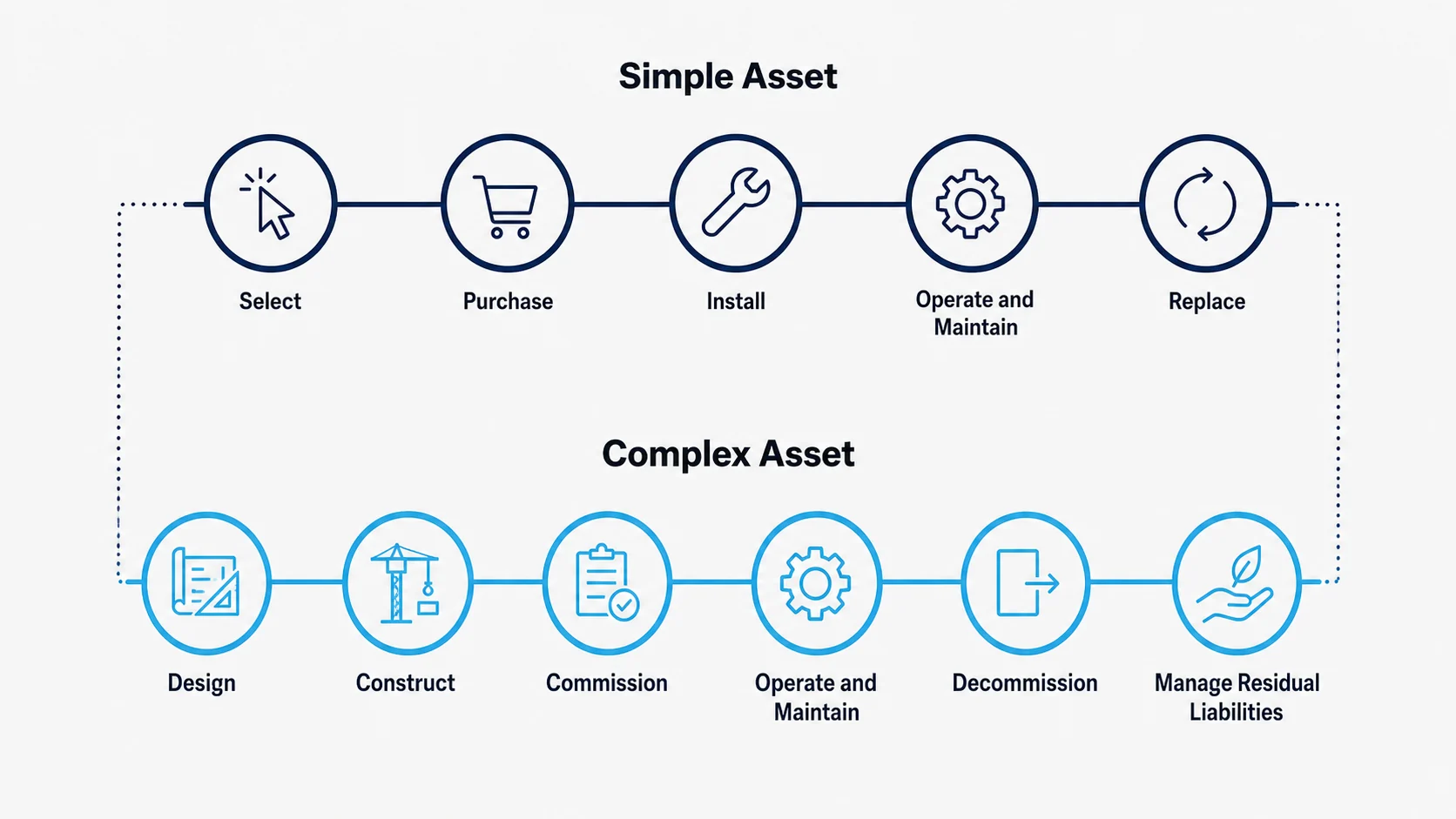
The specific stages an organisation uses to describe this arc vary by asset type and industry, and that variation is normal rather than a sign of an inconsistent approach. A straightforward asset can move through selection, purchase, installation, and operation and maintenance, then replacement. A complex asset, a processing plant or a piece of rolling stock, moves through design, construction, commissioning, operation and maintenance, decommissioning, and management of any residual liabilities. The naming and number of stages differ by industry and asset complexity. The principle underneath them does not: every asset has a beginning, a working life and an end, and every decision made at one stage carries consequences into the next.
Why the Acquisition Decision Carries More Weight Than Any Other
The single highest-leverage decision in an asset's life happens before the asset exists.
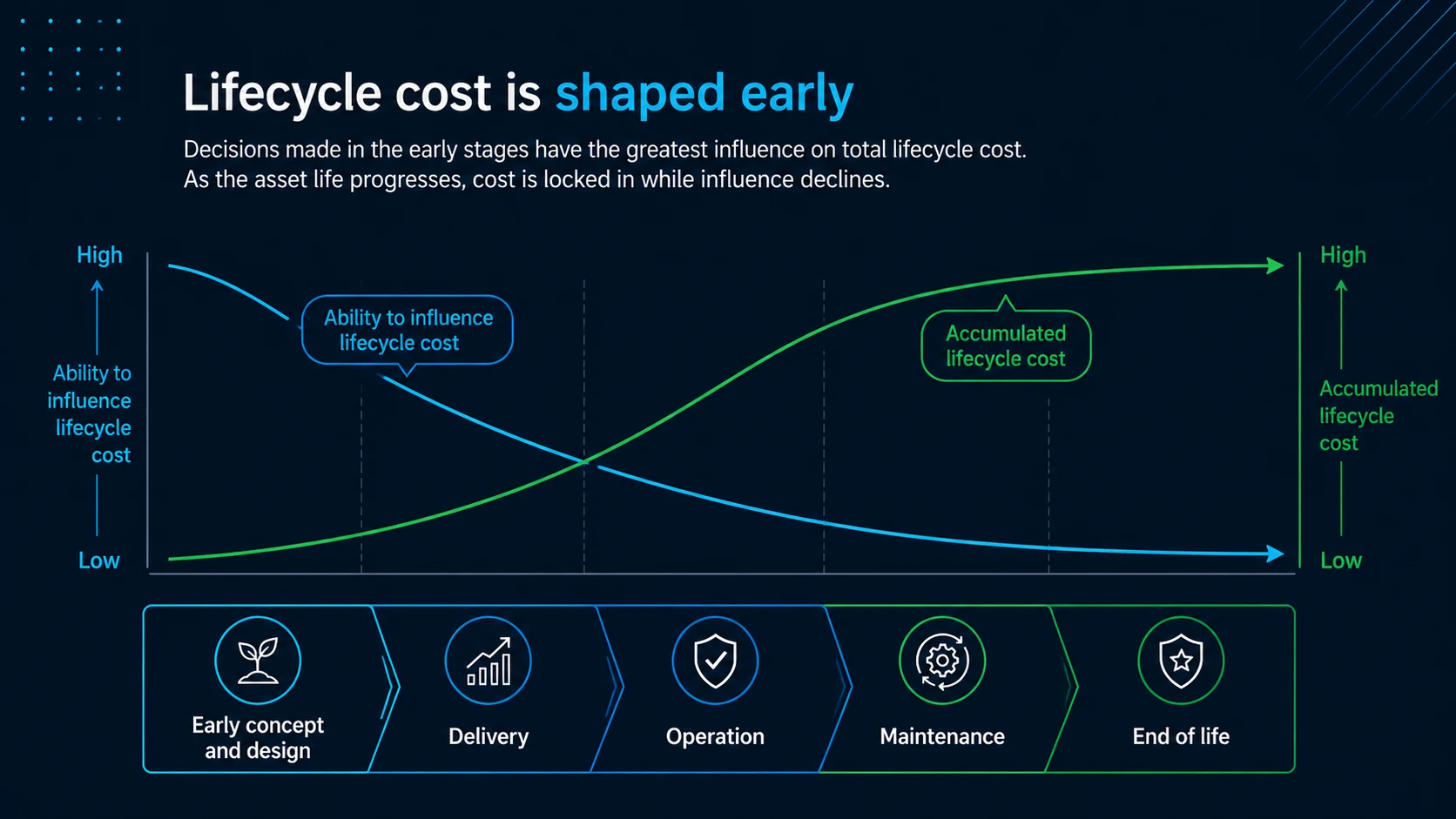
Material selection, redundancy design, capacity headroom, technology choice and maintainability are set at design and specification, and each one shapes the operating cost, reliability performance and eventual replacement timing of the asset for decades afterwards. This is why the design phase can determine as much as eighty per cent of an asset's total lifecycle cost, the share reported in the Institute of Asset Management's Anatomy of Asset Management (Section 3.5.3): the choices are made once, early, and then compound for the life of the asset. Two pump specifications that look similar on a purchase order can diverge sharply in total cost once duty cycles, spare parts availability and mean time between failures are considered over a twenty-year service life.
This is where the capital expenditure decision, CAPEX, and the operating expenditure trajectory, OPEX, become the same decision viewed from two different points in time. A design that reduces upfront capital cost by cutting redundancy or specifying a shorter-life component is not cheaper. It has moved cost from the CAPEX line to the OPEX line, and usually increased the total. Comparing design or procurement options fairly means comparing their combined CAPEX and OPEX across the same time horizon, at the same level of service, which is precisely what lifecycle costing and discounted cash flow techniques such as Net Present Value are built to do. The mechanics of building that comparison are a subject in their own right. The principle to hold onto here is simpler: the acquisition decision is a lifecycle decision, whether or not it is treated as one.
The Difference Between a Budget-Cycle Question and a Lifecycle Question
A budget cycle asks what something costs this year. A lifecycle view asks what it costs to own.
These are genuinely different questions, and they can produce genuinely different answers from the same set of facts. Capital expenditure and operating expenditure typically sit in different budget lines, are approved through different delegations, and are reported through different governance forums. That structure serves financial control well, but it creates a real risk: a decision that minimises this year's capital spend can shift a larger cost into next year's operating budget, and a decision that minimises this year's operating spend can defer a capital cost that arrives, with interest, a few years later. Neither decision is wrong on its own terms. Either can be the wrong decision for the asset.
Lifecycle thinking resolves this by treating CAPEX and OPEX as one number, Total Expenditure or TOTEX, assessed across the asset's full useful life rather than one reporting period. This does not remove the need for annual budgets. It changes what the annual budget decision is measured against: not what is the cheapest option this year, but what is the lowest whole-of-life cost option that still delivers the required level of service. That is a higher bar, and it is the bar that produces decisions an organisation does not need to revisit in three years. For a board weighing a major asset investment, TOTEX is the cost base needed to judge the return on capital employed, since it captures the full cost of the value the asset is expected to deliver.
Where Lifecycle Costing Enters the Investment Case
Every capital investment case should answer one question: what is the total cost of owning and operating this asset well, for as long as it is needed?
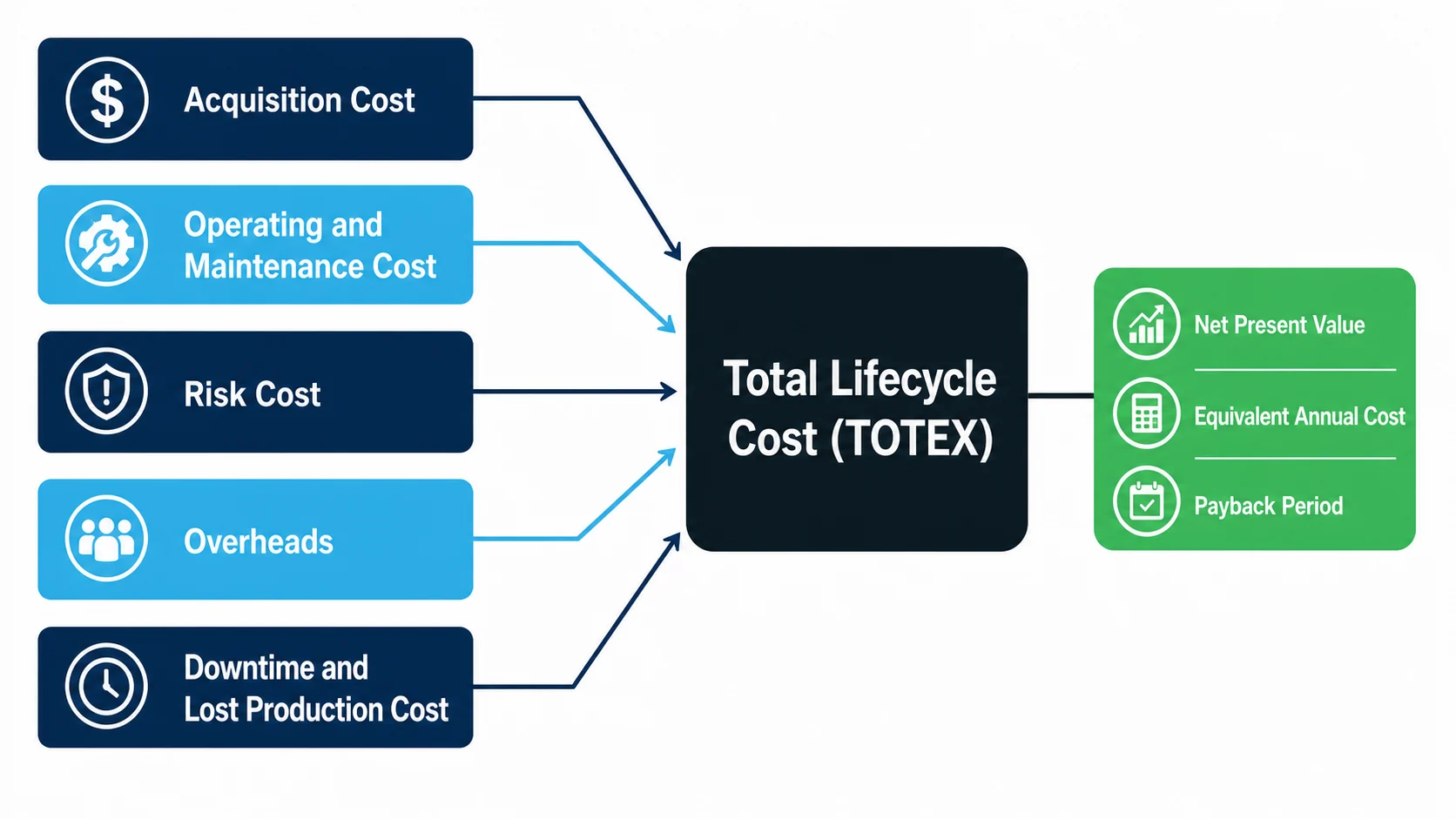
Lifecycle cost, sometimes described as total cost of ownership, combines the acquisition cost with the operating and maintenance cost, the risk cost of failure or underperformance, the overheads required to support the asset, and the cost of any lost production or service during downtime. Comparing two options with different capital costs, different operating profiles and potentially different useful lives requires putting them on a common footing. Net Present Value and Equivalent Annual Cost exist for exactly this purpose: these discounted cash flow techniques convert cash flows that arrive at different times into numbers that can be compared honestly, accounting for the time value of money. Payback period is a simpler screen of a different kind: it measures only how long an investment takes to recover its initial cost, ignoring the time value of money and every cash flow after the payback point, so it is useful as a quick filter rather than a basis for a whole-of-life comparison. The minimum acceptable rate of return an organisation sets for capital approval, its hurdle rate, exists so that a lifecycle comparison produces a defensible number rather than an intuition.
The same lifecycle lens applies to how an organisation monitors performance once assets are in service. Maintenance cost as a percentage of Replacement Asset Value is a widely used benchmark for this purpose. Well-managed continuous process assets typically run in the range of two to four per cent; heavy industrial and mining assets typically run higher, in the region of four to seven per cent, reflecting harsher operating conditions and higher consequence of failure. A ratio drifting well above that range across an asset portfolio is a lifecycle signal worth investigating before it becomes a lifecycle problem. It can indicate assets running past their economic life, renewal that has been deferred, or a maintenance strategy that has drifted away from the criticality and condition of the assets it is protecting. Tracked over time, the same ratio also speaks directly to return on assets, since capital tied up in a portfolio that costs more to sustain is capital not generating the return the organisation expects from it.
How Lifecycle Thinking Changes the Renewal and Disposal Decision
The moment an asset stops being the most economic way to deliver the required performance is rarely the same moment it stops working.
Physical life and economic life are different measures, and the gap between them is where some of the most consequential asset decisions sit. Physical life is how long an asset can continue to function. Economic life is the point at which the total cost of continuing to own and operate the asset, including its maintenance cost trend, its declining reliability and the growing consequence of an unplanned failure, exceeds the cost of replacing it at the required level of service. An asset can be well past its economic life and still be running perfectly well on any given day.
Identifying that point requires the same lifecycle data that lifecycle costing depends on: cost history, condition trend and failure frequency, tracked over time rather than assessed once. Without that data, the replacement decision defaults to the point of failure rather than the point of best value, and the point of failure is reliably more expensive and considerably less predictable. As an asset moves past its economic life, maintenance cost per unit of output tends to rise, reliability tends to decline, and both the probability and consequence of unplanned failure tend to increase together. Understanding this pattern in advance is what allows an organisation to plan a renewal on its own timeline rather than responding to one on the asset's timeline, and to build the capital case for that renewal well before the operating case forces the issue.
Lifecycle management also extends past the point of replacement. Disposal, decommissioning and the management of any residual environmental, safety or regulatory liability are part of an asset's lifecycle, not an afterthought once a replacement is commissioned. ISO 55001's scope over the full asset life includes this end stage explicitly, and it is increasingly treated as a governance and ESG consideration in its own right, not only an operational one.
Building Lifecycle Thinking Into the Asset Management System
Lifecycle thinking does not happen through good intentions. It happens through the mechanics of the asset management system an organisation already has in place.
A policy that commits the organisation to realising value from assets across their full life gives lifecycle thinking its mandate. A strategic asset management plan that sets clear objectives gives it direction. Asset management plans that schedule and cost lifecycle activities against those objectives give it a mechanism. Four practical elements make the difference between a system that states lifecycle intent and one that delivers it in the asset lifecycle planning that happens every day.
- Asset data captured consistently across the full life, including condition, cost and failure history, not only work order completion records. Lifecycle decisions are only as good as the trend data available to support them, and a gap in that history at any stage weakens every decision that depends on it afterwards.
- Lifecycle stages and decision points defined for each asset class, matched to its complexity and criticality, rather than a single generic model applied everywhere. A simple, low-consequence asset needs a lighter lifecycle process than a complex, high-consequence one, and forcing both through the same process wastes effort in one direction and risk in the other.
- Lifecycle costing built into the business case template for every material investment decision, so that whole-of-life cost is a standing requirement of the approval process rather than a calculation performed only when someone remembers to ask for it.
- Renewal timing informed by criticality and condition, not by asset age or a fixed replacement schedule alone, so that capital is directed to the assets where the consequence of deferral is highest and the return on that capital is greatest.
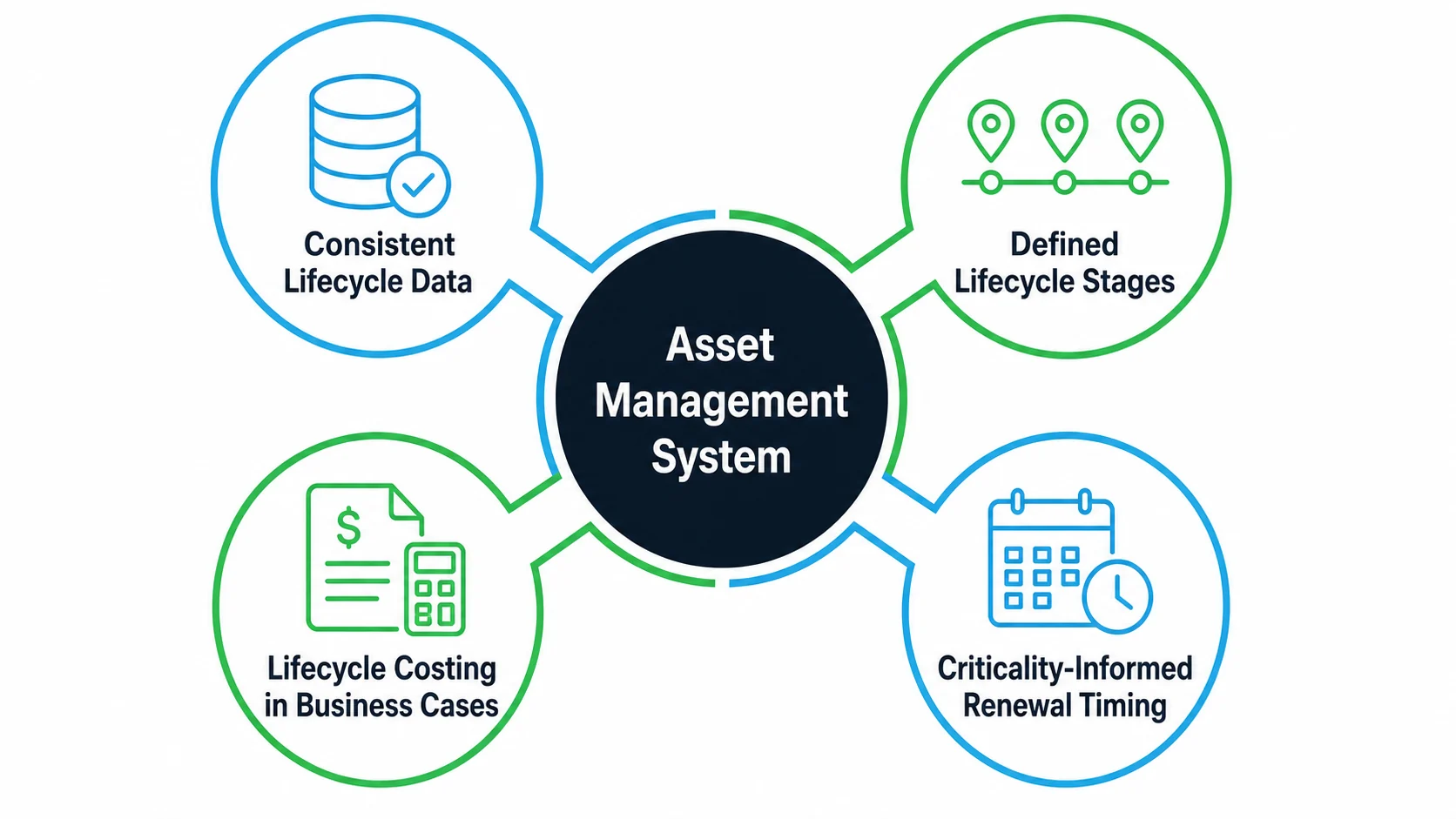
None of these elements requires a new system. They require the existing asset management system, policy, strategy and plans, to be used with the full asset life consistently in view.
Related reading: asset management maturity levels in practice, and the Data Standardisation and AI Readiness Framework.
The Question That Changes Every Decision
The question that determines the quality of an asset decision is rarely what does this cost this year. It is what does it cost to own and operate this asset well, across its full useful life, at the performance standard required. That single shift in framing changes what gets built, what gets replaced, when it gets replaced, and which investment cases can genuinely be justified to a board evaluating the return on the capital involved.
The organisations that get the most value from their assets are not the ones with the newest equipment. They are the ones that can answer the full-life question with confidence, because the data, the process and the decision framework are already built into how they manage assets every day. The next capital decision that crosses your desk is an opportunity to ask that question before the budget question, and to see how differently the answer reads.
Frequently asked questions
What is asset lifecycle management?
It is the coordinated management of an asset from the point a need is identified through to the point it is disposed of, repurposed or replaced. It is not a maintenance concept. The objective is the best total value across acquisition, creation, operation, maintenance, improvement, renewal and disposal considered together, rather than cost minimisation at any single stage.
Why do design and acquisition decisions carry so much weight?
Material selection, redundancy design, capacity headroom, technology choice and maintainability are set at design and specification, and each one shapes operating cost, reliability performance and eventual replacement timing for decades afterwards. This is why the design phase can determine as much as eighty per cent of an asset's total lifecycle cost, the share reported in the Institute of Asset Management's Anatomy of Asset Management (Section 3.5.3): the choices are made once, early, and then compound for the life of the asset.
What is the difference between a budget-cycle question and a lifecycle question?
A budget cycle asks what something costs this year. A lifecycle view asks what it costs to own. Capital expenditure and operating expenditure typically sit in different budget lines and are approved through different delegations, so a decision that minimises this year's capital spend can shift a larger cost into next year's operating budget. Lifecycle thinking resolves this by treating CAPEX and OPEX as one number, Total Expenditure or TOTEX, assessed across the asset's full useful life rather than one reporting period.
What is the difference between an asset's physical life and its economic life?
Physical life is how long an asset can continue to function. Economic life is the point at which the total cost of continuing to own and operate the asset, including its maintenance cost trend, its declining reliability and the growing consequence of an unplanned failure, exceeds the cost of replacing it at the required level of service. An asset can be well past its economic life and still be running perfectly well on any given day.
How do you build lifecycle thinking into an asset management system?
Through four practical elements: asset data captured consistently across the full life including condition, cost and failure history; lifecycle stages and decision points defined for each asset class and matched to its complexity and criticality; lifecycle costing built into the business case template for every material investment decision; and renewal timing informed by criticality and condition rather than asset age or a fixed replacement schedule alone. None of these requires a new system. They require the existing policy, strategy and plans to be used with the full asset life in view.