

Global Standardisation For Managing Assets
Shivaan Asset Management helped a mining client standardise asset management for global efficiency.
Mining78%Failure-code adoption within 8 months, from no prior use of codes
Mining
Shivaan Asset Management was contracted to perform a complete audit of the CHPP functional locations across both sites.

A coal mining company engaged Shivaan Asset Management to conduct an audit and gap assessment of their Coal Handling and Preparation Plant (CHPP) functional location taxonomies in SAP, for two of their coal mine plants.
The client recognised inconsistencies in how assets were structured, classified, and managed, leading to fragmented data, unreliable reporting, and missed opportunities for cross-site benchmarking and reliability improvement.
Our work spanned every CHPP functional location at both sites.
The scope of our activities included:
Shivaan Asset Management combined extensive Mining Process, Physical Assets and SAP expertise with a practical, on-site approach to evaluate the accuracy, consistency, and structure of CHPP functional locations.
Our team:
This end-to-end assessment identified key inconsistencies and improvement opportunities across both sites.
How a functional location hierarchy is built
Produced an example of Reference Functional Location utilisation to standardise Functional Locations of similar physical assets.
Our comprehensive audit successfully identified key discrepancies between the installed assets and the SAP data structure. We presented these gaps as clear opportunities for standardisation, improvement and future-proof asset management maturity.
The key findings and recommendations from our audit report included:
| Gap Identification | Opportunity & Recommendation |
|---|---|
| No enterprise standard for SAP Master Data. | Enterprise Master Data Standard covering the creation, governance (RACI: Responsible, Accountable, Consulted, Informed), and auditing of reference functional locations and functional locations. |
| Varying hierarchy levels (from L2 to L4) for similar plant areas across sites. | Standardise all functional locations using the new Master Data Standard, enabling clear benchmarking and performance-tracking opportunities between sites. |
| Functional Location levels were too high-level, missing critical asset detail. | Connect all similar assets to a common Reference Functional Location to standardise maintenance strategies, data analysis, and reporting across the business. |
| Construction types were not standardised or Bill of Materials (BOMs) linked to incorrect functional location level. | Standardise Construction types and BOMs for all common equipment types, linking them appropriately to reduce planning time, optimise spares, and improve work execution. |
| Component and Failure Codes were missing or inconsistently applied. | Integrate FMEA-based codes for use in Notifications and Work Orders, enabling powerful failure analysis, maintenance strategy optimisation, and predictive forecasting. |
| Gaps in SAP training and process adherence among staff and contractors. | Enhance user-side processes with targeted SAP training on use of Failure Codes, simplified data reporting dashboards, and a clear governance model to improve data quality at the source. |
The same failure code work, delivered in full for an oil and gas operator
By presenting these findings as a clear and actionable roadmap, Shivaan Asset Management provided the client with a blueprint for enterprise-wide asset management maturity.
The primary value delivered to the business includes:
By implementing a unified functional location hierarchy, Shivaan Asset Management enabled a coal producer to turn two siloed CHPP operations into a single, intelligence-driven asset network.
Now, for the first time:
A collaborative culture of continuous improvement, where data flows freely, decisions are trusted, and both sites work together, not in isolation, to drive reliability, safety, and business performance.
This isn't just master data cleanup. It's operational alignment at scale.
Site verification of CHPP assets, sub-processes and maintainable items, evaluation of the SAP functional location levels and structure alignment, a comparison of both sites to identify standardisation opportunities, a gap analysis with an improvement roadmap, and presentation of the findings through a structured audit report and an interactive session with client stakeholders.
Because the two plants used varying hierarchy levels, from L2 to L4, for similar plant areas, and the levels in use were too high to carry critical asset detail. Standardising every functional location to one master data standard, and connecting similar assets to a common Reference Functional Location, is what makes benchmarking and performance tracking between the sites possible.
Structured failure coding turns historical work order data into actionable insight, so past breakdowns support future prevention. FMEA-based (Failure Mode and Effects Analysis) component and failure codes are integrated for use in Notifications and Work Orders, which is what enables failure analysis, maintenance strategy optimisation and predictive forecasting.
The audit delivered a Work Management maturity uplift that positions the client's Asset Management System for ISO 55001 alignment, on the back of a standardised, governable functional location taxonomy and an enterprise master data standard covering creation, governance and auditing.
Shivaan Asset Management helped a mining client standardise asset management for global efficiency.
Mining78%Failure-code adoption within 8 months, from no prior use of codes
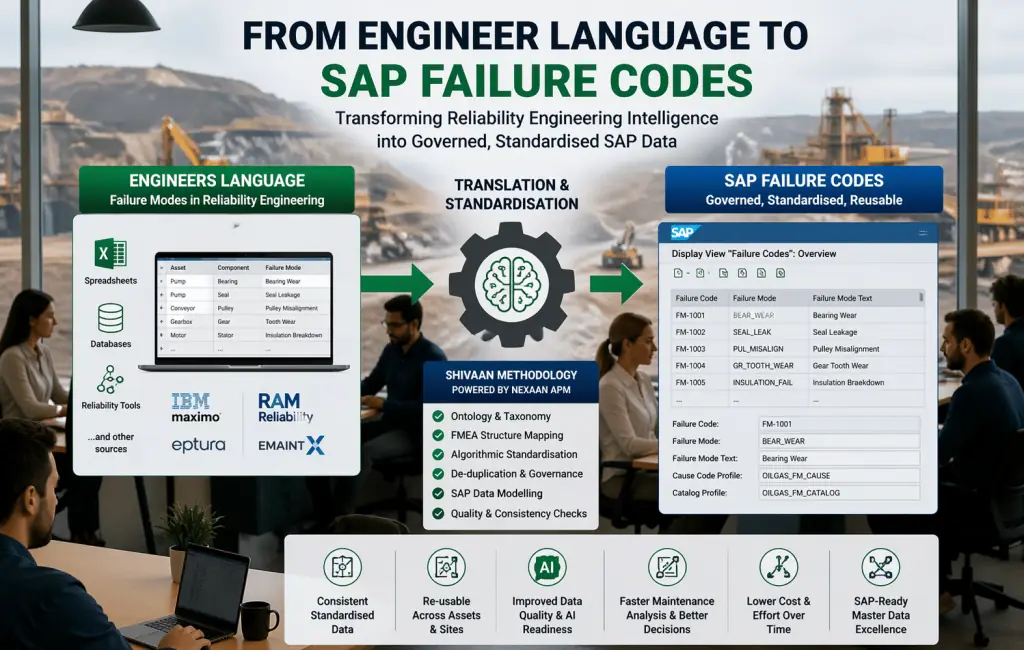
Shivaan Asset Management delivered SAP compliant failure codes (catalog profiles) for a Tier 1 oil and gas client, across 5 asset classes and 44 asset class types in 8 weeks.
Oil and Gas8 weeksTime to delivery
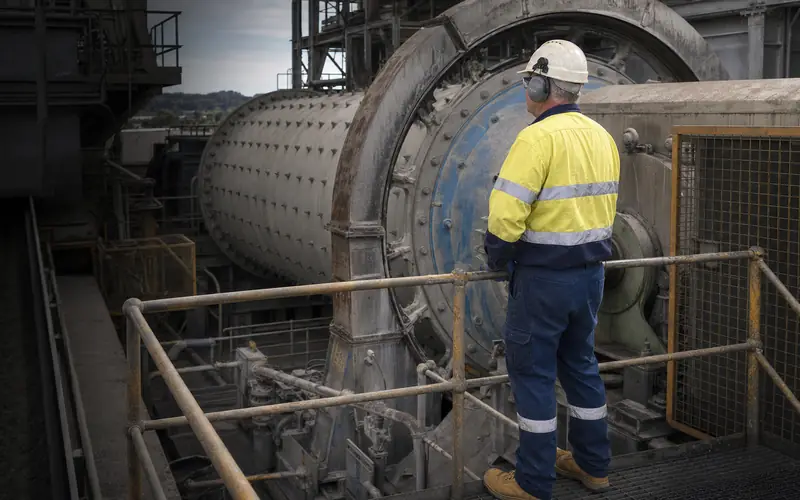
Shivaan Asset Management combined operating data, field observations and frontline expertise to improve grinding-circuit stability and retain critical mill knowledge.
Show us the asset system you are trying to improve, and we will map how this approach would apply to it.